Applying the flywheel and avoiding the doom loop beyond business

Several years ago, I picked up a copy of Jim Collins’ Good to Great, a business reference on why some companies thrive while other companies fail. In it, he made a number of great observations supporting the premises that the enemy of great is not bad, no “Good is the enemy of Great.” He speculates that because we preceive ourselves as being good at something, we can be lulled into acceptance of the status quo rather than incentivized to improve to the point of greatness. At least when we recognize we are downright awful at something we know to either quit altogether or seek additional help. With good, it is too easy to say, ehh.. it is good enough.

His book is really focused on the business world, but as I have embarked down the path of authorship and grown as a parent, I have found that many of his observations and tips for moving away from being just good enough to get by have applications beyond the office.

One of my favorite chapters in the entire book was on the topic of the flywheel and the doom loop. I’ve paraphrased a bit, but the two concepts can be summarized by the following steps:

Tunnels of Time
By fdecomite (Tunnels of Time) via Wikimedia Commons
The Flywheel

  1. Take a step forward consistent with your goal
  2. Verify Results
  3. Cultivate an audience of fans
  4. Build Momentum
  5. Repeat steps 1-4.

The Doom Loop

  1. Receive disappointing results
  2. React to results without understanding why the results were what they were
  3. Over-correct with new direction, new program leader, new event, etc
  4. Lose your audience & fans
  5. Repeat steps 1-4

The concept of the flywheel is simple, by taking small but determined steps according to a plan we grow a network of supporters which therefore makes repeatable success easier as it becomes nearly self-sustaining. A real life example is this: I am not a runner, but was talked into joining my husband on a 5K. I didn’t just show up for the race, I trained for weeks leading up to the event. At first it was just me putting one foot in front of the other. A successful day was merely getting home without walking most of the way. Then my family started to ask about how I was doing and suddenly I felt compelled to force myself to run just a few yards longer than I had the day before. On the day of the race, there were crowds of people shouting encouragement and offering water. I ran the entire way without stopping.

The doom loop is just as easy to understand. One of the bloggers I follow recently wrote of how she just received her first negative review. I can only imagine how devastating that must have been for her after working so hard. She easily could have gone on the defensive and lashed out at the reviewer. She might have caught herself questioning whether or not to continue to pursue her current project. In either case, the reaction could have cost the author her readers all together. Obviously creating a future of additional disappointing results. She did not do either of these things. She stayed clear of the doom loop and is most likely stronger for the experience. I wish her continued success.

I have found that writing in addition to working a day job and parenting is much like training for a race, except that this one is closer to a marathon than my little 5K. I have to pace myself to avoid injury and/or burnout. As long as I keep putting one foot (or in this case – one word) in front of another. Provided I keep watching my steps, I know that there will be someone just up ahead with a cup of cool water shouting encouragement. I will avoid the doom loop. I will finish this race.

Other Related Stories

Elaboration on my dedication

Our first-born found us in March of 2004. Actually, my in-laws were the ones to discover him abandoned off the side of a country road, only a few weeks old, near the body of his sister. They brought him home and showed us a picture. For my husband and I it was love at first sight.

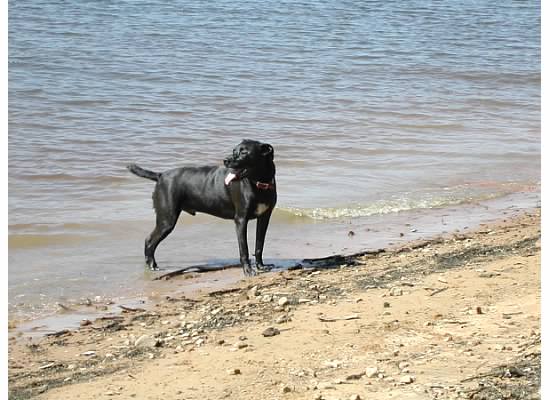
Before you begin to wonder where social services was in all of this, I will mention that our first-born was of the canine variety. He was a little ball of dark fur missing part of his tail. He was full of energy and sharp pointy teeth that he exercised on everything! I joked that he embraced the design style made famous in the Ben Stiller movie, Zoolander, pronounced Der E leak. If you ever wanted sensitive papers shredded, he was your go to pup.

Thankfully, he eventually grew out of puppy teething and into a positively wonderful friend. Sure, he brought in mud, occasionally stank up the house, and often barked more than we’d like – to this day I maintain that the cat across the street purposely enjoyed taunting him by laying about in full view from our picture window knowing he couldn’t do anything about it. But he was loyal, protective, and caring.

He was a mixed breed, but most likely contained more than a little pit bull in his genetic make-up. Had I known that at the time we adopted him, I may not have been so quick to add him to our family. I have since learned that there is a lot of misunderstanding about the breed. Unfortunately, this misunderstanding can extend into some dog care facilities as not all places will accept pit bulls (or pit bull mixes) as clients. As a result, we took our dog everywhere with us.

He had been the center of our little family for more than 4 years when I became pregnant with our first son, and I was extremely apprehensive about how the dog would adjust to a new living thing in the house. One of my co-workers gave me a CD of baby sounds to play in advance of the new addition so that our dog could get used to the noise. He would whimper when I played it, desperate to rescue the child from the stereo, but I do believe it made the transition easier.

During this same time, my husband was traveling extensively for extended periods of time. He hadn’t yet gone into business for himself. More than a little hormonal, I might have not handled my husband’s absence as well without the comfort of our dog by my side.

Whether it was the preparation work, or just our dog’s nature, he adjusted beautifully to the new pack structure after our son was born. For a very brief period, they were even roommates. Our dog would look at our son in his crib through the window of his crate as if to say, “so… what are you in here for?”

When I was working from home or otherwise writing, our dog would lie on the couch beside our computer twitching as he chased dream cats. I learned to never schedule a conference call around the time the garbage trucks would swing by, at least not a call that I was going to have to do more than just listen into with the phone on mute. If I moved into a different room, he’d follow along. I jokingly referred to him as my assistant.

He should have been ten years old this year, but unfortunately a mast cell tumor took him from us a year and a half ago. If there was any silver lining, the time between diagnosis until point of passing was relatively quick, and neither of our sons were old enough at the time to truly comprehend what was going on. Our older son still occasionally asks about him, but our youngest son will only know him through pictures and the random story.

We often get asked if we will get another dog. I suspect we will…one day. The world is too full of unloved animals waiting for a second chance, for us to ignore indefinitely, but there will never be another Ajax for us.

An Uncertain Faith was dedicated to his memory and I still miss him every day.

While we might not be emotionally ready, if you are at all interested in adding a pet to your home, please consider a rescue animal. If you have a pet, monitor their skin just as you would your own. Skin cancers are not just limited to people and do not have to be a death sentence if caught early enough.

Ajax

Don’t discount the power of a name

The tag pile
The tag pile (Photo credit: nightthree)

I came across a discussion in one of my Goodreads groups on how authors select names for their characters and I found it to be a rather interesting discussion. I happen to fall into the category of people who think that the meaning behind a name is an important consideration. Not just when creating fictitious characters for a story, but in all things.

For example, one of my sisters met a woman who was joyfully describing how she had selected a very unique sounding name. When asked to spell the name out, my sister learned that the woman had inadvertently bestowed upon her new daughter the name of a sexually transmitted disease. I will grant her that the young girl is probably not going to come across very many others with the same name in her life span, so if unique is what the mother was going for, she achieved it. Poor girl – if only her mom had done a quick reference check. I believe her mother thought she was naming her daughter after a flower.

When naming our sons, my husband only wanted to make sure that the names we selected had a family connection. I on the other hand not only researched each and every name for its meaning, but I also checked out their potential initials for negative connotations, whether or not the combination of first and middle name matched historic figures with questionable reputations, and went even so far as to try to pick a name that’s meaning spoke to both their anticipated Roman and Chinese Zodiac characteristics. Okay, maybe I took it a little too far. An aside, my older son choose to be several days late, nearly ruining my well thought out plans.

Perhaps I should have gone with a colleague’s method – pick three names that sound good to your ears when you are yelling for your child to pay attention for the tenth time. As she is the mother of four, it is a good tip.

As I mentioned above, I believe that the importance of names is not just limited to the selection of first (or middle) names. One of the neat things about my day job is my exposure to how things are named within other companies. There are companies which give their project bland alpha numeric codes and ones that allow their teams to come up with an internal names as if they were military operations. Project Silver Bullet, Panther, etc.

Trust me, the actual products that go with these project names aren’t nearly as exciting, but the creative names give the team something to rally around better than the numerically assigned names. Granting the team the ability to name their own project helps make a team feel more empowered and vested into the project’s success which is ultimately better for a company’s growth.

I also came across another company where they really had fun with professional titles. For example, their human resource department was known as “inmate control” and their quality assurance department, the “SWAT Team.” You could assume a lot about their company culture just by looking at their business cards. I can only imagine how much time they just saved in the interview process by breaking from tradition and renaming their job functions. Job seekers turned off by the non-traditional names need not apply.

The point I am trying to make is this – there is power in names whether or not you choose to do the research behind their meaning. Even if you don’t particularly care about the meaning, there are people like myself out there who will make all sorts of assumptions about a story, person, or company based on nothing else. Please don’t rely on a random name generator. At least not for anything above the status of ‘extra.’ If you can’t come up with a name, at least give another human a chance at it.

When there is so much else in this world that is out of our control, it is so nice to be able to sit down and decree that henceforth you shall be known as ___.

Some links worth checking out:

Enhanced by Zemanta

Wait…haven’t I been here before?

English: Photographic composition of Granmata ...

When I began to research self-publishing channels I of course had heard about Kindle Direct Publishing. The success stories from that platform alone made me believe that nothing could be more simple. Obviously I was more than a little naïve.

I mentioned my aspirations about writing to a former colleague who just happened to play tennis occasionally with a New York Times Best Seller. I did not have a completed manuscript, nor did I have a ton of materials which would help support my credibility, so the only advice that author was able to suggest at the time was “write a good story.” He did however direct me to www.millions.com through which I found the self publishing channel I selected.

I knew wanted at least one physical copy on my shelf, however I felt I would have the best chance for success through e-book sales. Additionally, while I was a huge fan of my kindle, I knew at least a few of my family members were Nook people so I wanted to make sure my book would be available on a number of platforms. At the time, Kobo wasn’t even on my radar. I have since learned since that it should be. (I am happy to report An Uncertain Faith was recently added to their catalog). My dad wanted it on iBook, but as Apple requires exclusive content he would just have to read a physical copy.

Two Paths Diverged in a wood
Two Paths Diverged in a wood (Photo credit: Wikipedia)

Now I am getting close to the halfway mark on my second project and even though it is a long way from a final draft (I still haven’t settled on the title yet either) I can’t help thinking about how I want to bring this one to market. Ok so maybe I am a little guilty of putting the cart before the horse, counting chickens before they hatch, etc. And yes, of course I would love to have a sweetheart deal offered my way out of nowhere, but I am at heart a long-term planner and need to have a realistic plan B and C. Do I stick with what worked for me once, or do I try a new path?

I know I still want to have a multi-platform distribution plan. Kobo may not have the same online presence that Amazon does, but it is the only reader supported by my brick and mortar channel. My seller’s rank also is not nearly as volatile there (which is both a good and bad thing). I definitely want an option that allows for physical copies as well. Print on demand is nice as it has prevented my garage from being overwhelmed with copies, but it has a price point which deters some would be readers.

My personal network was incredibly supportive when my first book was released, but I don’t know how deep that well will be again. People forgive a number of mistakes on your first attempt, but will they be as forgiving on my second?

Just in case any of you are finding yourself in the same place as I am here are some tips I have learned along the way.

Other authors out there – did you stick with what you knew, or did you try something new for book number 2?

Enhanced by Zemanta

Distractions do not have to be the enemy of progress

Cover of "Are We There Yet (Backseat Book...
Cover of Are We There Yet (Backseat Books)

Growing up my family regularly took road trips up north to visit our relatives. Now that I am grown with two small children of my own, I don’t quite know how my parents managed to maintain their sanity with three children in the back seat prior to the invention of in-car entertainment systems.

I do recall a number of trips that either began or ended in the wee hours of the morning, but the evening just wasn’t quite long enough to get us all the way there without a few hours of awake time.

We playing the required car games, such as I see something that starts with the letter…, sang songs, played twenty questions without the benefit of a suggestion deck, among other things, but my favorite memory remains the story rounds. Each of us would take a turn telling a part of a story, then you had to wait while the other members of the family added to the story. You had no idea what they were going to have happen and would have to pick the story back up from where they left it when it was your time again.

That is unless your turn followed my kid sister’s. She was extremely young when we started playing these games and so didn’t quite grasp the concept. Rather than continuing on from where the last person left it, she would go rogue. Making up random short story elements and characters that had absolutely nothing to do with anything. We started calling her additions the commercial breaks.

Sometimes the ‘commercials’ ran long and you had to really try hard to remember where the main story had been before it was interrupted. Occasionally this actually worked for the story’s benefit. We had to remind ourselves about the setting or key plot points. Strong stories would get reined back in and would be refocused, weaker stories however couldn’t survive and were scrapped, forcing the family to start the story round over anew.

Creativity, focus, and follow-through are critical traits in any profession, however you will never know the depth of your commitment and determination until you have been thoroughly tested.  As the fantastic line goes “All work and no play makes Jack a dull boy.” Distractions don’t have you be your enemy. Take a step back and allow yourself downtime provided it is in moderation. If you come back and can’t regain your enthusiasm for a project (or story), then consider that a warning sign. Take the opportunity to rework some aspect of it. The public will thank you.

Enhanced by Zemanta