Happy Mompreneur Monday everyone! Let’s start this off with a bang. By talking about the Big Fs. Fear and Failing.
I was humbled and overwhelmed (in a good way) by your positive response to this whole Mompreneur Monday idea. And as I listened to my friends and read the comments on facebook and on my last post, it became pretty clear that the biggest thing holding us back from starting our dreams is fear. And more specifically, fear of failing.
Olivia and I were building the tallest tower the other day. Our goal is to build a tower from the floor to the ceiling. And we’ve come really close, but it keeps falling. So the other day, we were building and building and without warning, it toppled over. I was disappointed. Frustrated that our hard work was sitting in a pile of rubble in front of us. Pondering the…
When I first meet people we touch on many of the same topics – you are a parent? Why so am I! How many kids do you have? What are their ages? What does your spouse do?
The answers to the questions on kids usually net the same responses “aww…, you must have your hands full… or, I remember when mine where that same age.” But the responses I receive when I tell people that my husband owns his own business can be quite varied. I can always tell when I’ve met another supportive other-half based on his or her sympathetic sigh, and I’ve found there are a lot of pre-conceived misconceptions out there on what it means to be married to an entrepreneur.
1. There are no weekends or PTO days.
This truth comes home each and every time one of our children bring home one of those fun viruses they grow in daycare. Or even worse – if he comes down with an illness himself. He risks our children’s future each time he misses, or is forced to reschedule, a meeting as his competition can easily fill up that opening on the potential customer’s calendar. This means that sick days are stay home with mommy days. Not 50% stay home with mommy and 50% stay home with daddy days. Of course this puts me at higher risk of developing daycare plague myself, and I don’t handle being sick well. Even when he is at home, he is never far from his work. One day, he will be able to turn these meetings over to someone else, but that day isn’t today.
2. Just because he is the boss, doesn’t mean he controls the schedule.
Not too long ago, one of my colleagues was considering hiring a new staffer. As we compared notes about the candidate, she mentioned that the potential new staffer’s husband was in business for himself. She thought this was a selling point for the candidate as she believed it would allow the candidate additional flexibility in working hours.
It doesn’t. See truth #1. I have to leave my day job at close of normal business hours on the dot to pick up our children as the husband could be in any number of places within the state. I am lucky to have my day job with a family friendly organization that understands how quickly the meter runs at a daycare for every minute you are late for pick-up. But there are a number of organizations out there less sympathetic and I know my boss would prefer to see me around the office longer.
An aside – we still hired the candidate, because she was a great fit, but I had to laugh at my colleague’s rationale.
3. The checks coming in are made out to his company – not to us.
Profits are spent on labor, overhead, supplies, and re-investment in the company. Yes, some of that labor number does come back to us in terms of salary, but that number is no where close to the number reported for chief operating officers in publically traded companies.
Never, ever, think outside the box (Photo credit: Mrs eNil)
When employees make careless mistakes, that comes out of company profits, and if the company isn’t profitable, then our family’s financial security is as much at risk, or even more so, than the employee’s. On a more selfish note – I don’t mind working a day job and writing on the side if its something I choose to do. I do not appreciate having the choice taken away from me over something that could have been prevented.
4. The overnight success takes at least five years of work.
Unless you live in Dr. Seuss world and sell Thneeds, growing a business from start-up (or writing a book) takes long hours, hard work, sacrifice and a measure of insanity. If you and or your significant other can’t accommodate truths 1 – 3 over the long run, you really shouldn’t try. It will ruin your relationship along with your finances.
Expectant mothers, people with heart conditions, or those who experience motion sickness a/or seasickness should also proceed into first time entrepreneurship with caution. There are a ton of rapid up and downs. Rollercoasters pale in comparison. You may lose your lunch.
5. There is a big difference between being self employed and being an entrepreneur.
To be a successful entrepreneur means finding a team of people who can help support your vision and who can build on the company’s momentum in their own way without you. I may not receive a paycheck from my husband’s company, but I am just as vested in its success.
Entrepreneurship (or being the supportive other-half of an entrepreneur) isn’t for everyone, and there should be no shame in admitting that about yourself, preferably before you file any paperwork with your local city or bank and find out the hard way.
If our kids had already been born, we may never have started this journey together, but even now I don’t regret it. I doubt either of us could go back. When writing a book, I found the blank page at times to be overwhelming. Much like when he started his business. I was thankful to have him in my corner supporting me throughout this process, urging me on, and helping to sell my books when he can. Together we found in business and in authorship, you must first start with a letter.
I am asking people to weigh in on what type of title most appeals to them on my facebook page (https://www.facebook.com/alliepottswrites) because frankly I need all the help I can get coming up with a title for my current project. I’ve run through at least five working titles and still haven’t found the one. I ran into a similar issue when selecting the title for my first. By comparison, I found naming my characters significantly easier.
In my first novel, my protagonist’s name was Charlotte, selected because it quite simply means feminine and I wanted her to represent an average woman. There is a mystery element to the story, but for obvious reasons I couldn’t title her story Charlotte’s Web. I am rather proud of the ending and did not want to give anything away, so that further limited what imagery I could include. By the same token, I don’t expect the reader to particularly like her during the first act in the book, so I definitely didn’t want to pull imagery from that section either. I ultimately decided to create a title that summarized the underlying premise of the book, but it was a difficult decision to make. I had just spent the last several months of writing to develop a premise, and here I was trying to refine it down to a catchy 1 – 3 words.
Thankfully I worked with a professional cover artist so that I was able to avoid a similar situation when selecting the front.
So now I’d like to open the topic up for comments from the public. Authors, what inspired you to create your own titles? Did you create the title first and then write the story or vice versa? Were you lucky (or not so lucky) to have your title selected by a publisher’s working group? Readers, what kinds of titles draw you in?
My husband and I were both recently made victims of cyber crime. I was one of those misfortunate enough to have their credit card information put at risk during Target’s security breach ahead of Christmas while one of my husband’s employees made the mistake of opening an attachment from an unknown source on one of the company computers.In my case, my bank was made aware of the breach before I was and responded by sending me a new card. Additionally I was have been notified that I will receive free credit monitoring. In my husband’s case, files were instantly encrypted and he was advised that he would have to pay a ransom in Bitcoins in order to get his own data back. Even then there is no guarantee that the guilty parties will reverse the damage. There isn’t exactly a better business bureau to report them to.
Luckily he and his personal computer were off site when the attack happened, and he had the foresight to maintain critical files on another server, but the damage to the business is not something to shrug off. I will admit that my first reaction to this news was worry about the virus spreading to our home machines. I couldn’t help thinking of all of our family photos as well as my work in progress. It doesn’t matter that we’ve made a point to have back-up redundancy, it still made me shudder. I don’t know what I would have done if those files were suddenly inaccessible.
After the initial panic subsided and he assured me that the situation was contained, I started thinking about how villainy has been romanticized in pop culture and literature. For example, Robin Hood – yes he was a thief, but one that helped people. The end justified the means. Clint Eastwood’s character in Unforgiven sets out to commit murder, but by doing so can earn money to help his children while righting a attack against a woman. We can ignore the crimes when crimes are against bad people.
I will admit then that both of these recent crimes have confused me. The typical Target consumer isn’t exactly splurging on things like caviar and truffles. They aren’t getting offers for unlimited black credit cards. My husband isn’t struggling to keep his business afloat out of our garage, but isn’t exactly a fortune 500 company (yet). To me, it seemed as if the risk of getting caught outweighed the potential gain. The breach at Neiman Marcus made more sense.
That is until I remembered that the perpetrators from either crime are most likely not from the US. Stealing those last $12 dollars from a person’s bank account could mean life or death. As ads for various charities like to remind me, a quarter per month could save the life of a child.
Still those last $12 dollars could also make the difference in keeping the victim’s power on or off in the midst of a polar vortex when the bill comes due.
I will admit that I do enjoy the recent trend of stories and shows about the antihero, and/or evolution of the villain. I am in no way shape or form advocating that they go away. They are actually some of my personal favorites as I believe that they provide us with characters that have depth and stories that can go in multiple directions.
Some believe that these stories are promoting the criminal lifestyle and in turn creating more crime. Others, that these stories are merely a reflection of our existing society. I’m not sure where I fall within the spectrum after the last month. I just require that they don’t gloss over the fact that there are always consequences, no matter the intention.
As I’ve mentioned previously writing is only one of the many hats I get to wear on a daily basis. Unfortunately as I was changing out my desk calendar I was reminded today that the party is over. I need to put on my boss hat and get started working on the dreaded performance reviews.
Yes, I do have direct reports (no I didn’t force them to buy my book), and yes I do dread the performance review as much as they do or more. Why is that? Because my work requires us to complete reviews in a one-size-fits all format which can put people on the defensive. Additionally my office is not very large and so I am very familiar with why an individual did or did not complete their annual goals for the year without the need for another meeting.
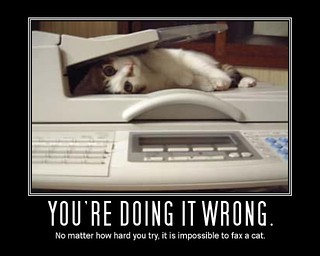
fax (Photo credit: anomalous4)
The part I dislike though most about the process is where the manager is expected to provide constructive criticism. The trick is presenting it in such a way as to motivate the person towards changing the behavior in the long-term rather than instigating a finger-pointing war. There was a Dilbert carton recently which showed the pointy haired manager reminding himself to criticize the behavior, not the person. In typical Dilbert fashion, he failed miserably. Hopefully though I’ve offered suggestions to my staff throughout the year, making this requirement on the form redundant.
You have to be able to first identify what motivates the individual and then how to best leverage that trigger into their work. However it is just as (or even more) important that the person being reviewed respect the reviewer, otherwise there will be no change. As an aside, I would expect that the majority of my protagonist’s from An Uncertain Faith reviews haven’t gone so well as of late.
Authors should be able to relate to this concept as much of the same work goes into effective character development. When I was developing my character notes, I had to describe to myself what was this person’s core needs? How did they respond when under stress? Some of these notes made it into the story verbatim, some were probably less obvious to the reader, but helped when it came to dialogue. I didn’t take the time to properly sit down and review my characters on previous writing attempts definitely contributed to my writer’s block and ultimate failure on those attempts.
It is much easier to write what should be done when preparing and conducting performance reviews than it is to actually do it. In my case there is a generational gap between myself and some of my staff. It didn’t take me more than a week on the job to recognize that what motivates me professionally is vastly different from what motivates a person closer to retirement or one just entering the work force. I would recommend that anyone attempting to write about a character vastly different from themselves study up on how to motivate those not like you or managing different generations.
This site contains affiliate links, which means I may receive compensation when you click on a link to a third-party site. I am also a participant in the Amazon Services LLC Associates Program, an affiliate advertising program designed to provide a means to earn fees by linking to Amazon.com and affiliated sites.