Blog

Senior dog with tongue partially extended. Dog appears happy

You’re Still With Us – A Dog Letter

At the time of this writing, you’re still with us. You’re sleepier than you were before, which is somewhat hard to believe, and quieter too, but you are just as sweet. It’s funny to think of how we’ve grown together and what you’ve helped me accomplish. Considering how often we called you lazy, thinking back to those early years, it is impressive how much we experienced together.

Remember how you broke through the fence to explore the neighborhood. Not once, but multiple times no matter how we tried to fix it? How you’d disappear into the woods behind our house only to show up later on someone else’s porch? But how you would stop in your tracks if out on a walk and run back home if you recognized your dad’s truck. How our lives have changed.

In those early years, do you recall how you’d always find someone else to snuggle with other than me if given the option? You’re by my side, now, like there’s no place you’d rather be. There’s no place I’d rather you be either.

I know I wasn’t your person when we first brought you home. You made it clear how much you preferred your boys and oh, how your boys loved you. Do you remember the first time they stayed away overnight; how you spent the evening on the stairs looking out the window waiting to spot them coming home to you? Do you remember how you paced in their rooms sure that they must just be hiding from you? If you could just catch their scent, there wasn’t a doubt in your mind that they would jump out to give you a hug, the way they always did.

I do.

And here we are, faced with the knowledge that when this letter is made public, the reverse will be true. It will be us missing you.

It’s a terribly short time now, and yet, it’s been terrible long months coming.

To think, it all started with a bump on your cheek and the words, “mom, I think she’s been stung by a bee,” though it was January and bees far from flying. How that evil bump grew and grew while the ice and snow melted away as if once spotted it consciously went on the offensive.

There were days I wasn’t sure we’d even have time to be seen by the doctor. But you kept on. You were a rescue, a stray, a survivor. You were always good at finding a way forward, even in the toughest conditions.

Remember that time we attempted to keep you in a crate while on vacation and you bent the bars until the door was open? I do.

Remember how you figured out how to open the wooden shutters so you could see the street? I do.

Remember how you could convince your dad you could do no wrong simply by wagging your tail though you’d brought in mud from a hole dug in the yard? I do.

I’ve been keeping a running list of the things you love ever since your diagnosis. There was swimming and sunning. Remember the times we went to the beach and how you’d never fail to steal my chair. There were car rides and cuddles next to your brother in bed at night. You could never have enough blankets and pillows. Nor would you ever let us forget to give you the collection of treats at the end of a good day we affectionately referred to as your value pack.

I wish this list would never end. I wish there was more I could do.

We knew the prognosis was grim from the start, but we never once considered not trying, and for a while it seemed effective. But the treatment made you tired and unsteady on your feet. You were still with us, but it was no longer safe to allow you to sleep on the bed with the boy. I saw how you flinched at anything other than a gentle touch. And so your sleeping arrangement changed. There was no more rough-housing, no more tough play. Cuddles were crossed off the list–or at least strictly limited.

I hated that you didn’t seem to mind. To be fair, I’ve hated every part of this. But I’ve never hated one minute extra we’ve spent with you.

Car rides were the next passion to go. I don’t blame you. Your appointments were an all day, every other week event. We’d have to battle through traffic to get across town, only for you to wake up sore and very disoriented. Who would have enjoyed car rides after that? Even with the window open. It made me start to wonder, was it even worth it?

But then you’d smile a post-op drunken smile, come to my side, and I know I’d do it all again.

Remember how we celebrated the day of your last round of radiation with special treats, which I had to steam to soften enough for you to eat? You’d lost interest in the others. It was a far cry from how you used to run and jump to break sticks, or how you could tear up even the most “indestructible” chew. Oh, the damage you could do. You had a gift for destruction, but a gentleness too. You were always calm around children, allowing them to approach you first. You never lunged at anything but a squirrel, except on the rare occasion when food was involved.

That’s okay. I accepted this love for your daily indulgence had to be scratched off the list too. And so, we did our best find a way to keep up your appetite in spite of it all.

But then your teeth started chattering again in a way that had nothing to do the outside temperature. We learned the radiation had damaged the bone and there was little more than we could do. We were given more pills. You dealt with more challenges. Whatever it took. As long as you were still here with us, we were still here with you.

The weather warmed and we looked forward to swimming season. We brought your favorite floating toys out and to your credit, you chased after them once, but have not picked them up again. Remember that time at the lake, you wouldn’t stop fetching though the rest of us had long lost interest? I do.

It got warmer. You chose to stay in the shade rather than stake your claim on a deck cushion. A first. Another item crossed off the list.

Only during this time you weren’t the only one in the shadows. The lump returned, this time deeper in your throat and shoulder, where it couldn’t be as easily detected and we were finally forced to voice the truth we all knew, but no one wanted to say out loud. The time had come to address the one thing on the list of your loves which we’d never crossed out–your love for us and our love for you.

It hurts so very much, this mercy we’ve chosen. I know that you won’t understand, though there are times when you’ve looked at me with those big brown eyes and quivering lip, and I wonder if you do.

I worry that we held on too long. I wish we could have held on longer. The coming days, weeks, months will hurt for us. At least they will no longer hurt for you.

You will always be daddy’s princess. You are the boys’ comfort and source of pride. You know that, but know you will always be mommy’s sweet girl too, even if you’re also the toughest, most stubborn girl I’ve ever known. You’re still with us, if only in our hearts and memories, forever.

We love you, T.

black and white photo of a senior dog sleeping on a pillow and blanket
I’m sorry, I never did give you enough pillows

Tent For Seven: Totally Not A Book Review

Amazon has rules. Rules about who can and cannot post a review. Rules about what you, as an author, can and cannot say about another author’s book in your review—unless you don’t mind getting all your reviews taken down. The appeal process isn’t exactly biased toward forgiveness either. So when I say this post is not a review, believe me.

But I want to talk about this book, and more importantly the authors behind it anyway.

Book cover for Tent For Seven featuring a tent, mountains, fire, and a smiling bear.

Full disclosure, the reason I cannot post an official review about Tent For Seven: A Camping Adventure Gone South Out West by Marty Ohlhaut and Grace Ly is because I am biased as heck. Their family is part of the village that raised me. Considering they were a family of seven at the time (they’ve since multiplied), one could say they were a large part of the village that raised me. I’m also biased, in part, because I knew the story behind the book before it was published, or at least, I thought I did.

Growing up, Marty Ohlhaut was Grace’s dad. He still is, but what I mean is I viewed him in the same way I viewed pretty much every one of my mom and stepdad’s friends—a grown-up. He was funny (also still is) but in the back of your mind you always knew that all it would take was one ill-thought-out leap down their sloped backyard, a broken planter, or similar misstep to get sent home with a call to your mother. In my case, those calls could result in a grounding (depending on the infraction) and a bye bye to my social life.

In other words, I didn’t know him outside of his parental persona. I certainly never guessed he was winging life as much as I was (am). The only hint I ever had of the person behind the parent was the time we were trying to make cookies and realized we needed maple syrup for the recipe, which we didn’t have. No problem, we’d go down the street and ask the neighbors for some.

The Ohlhaut children were happy enough to help (cookies were on the line!). They thought they had some extra syrup… somewhere. Where was it? Oh yes. Eventually, they handed us a bottle of brown liquid. Crisis averted! Cookies were in our future once again. Only, it turned out that bottle wasn’t filled with maple syrup at all. It was their father’s whiskey, cleverly disguised.

Our mistake was caught in time and no whiskey was wasted on children’s taste buds. We got a good laugh out of it, and I am sure that Mr. Ohlhaut gained a valuable life lesson from his children’s unquestioning generosity while also learning more about proper storage techniques for potent potables.

who needs a tent when a 1998 Coleman Mesa is available for rent?

Which brings me back to his book. If you have ever camped before (not glamped as I prefer to do, especially as I’ve grown older—actually camped) chances are you are already well aware that things often go sideways in spite of the best of planning.

Now imagine everything going wrong, in another country, without access to a cell phone, or really any civilization, for days. I can sense you shuddering from here. I know I did when I started reading their account.

Were you to cut your losses, pack it in, and go home while vowing to never step foot in the great outdoors again, no one would blame you. Instead, they pressed on, bolstered by the strength of their family. I say “they pressed on,” because while the book is Mr. Ohlhaut’s perspective, it is clear throughout the pages how much his wife’s support and his children’s positivity played a critical role in the decision to continue forward, no matter how much he tries to convince you it was purely about the logistics or finances.

This decision to keep traveling also puts them in the path of various people whose timely appearances will make you wonder how much can a person reasonably brush off as mere coincidence. As a result, even if I didn’t know the backstory, I would still highly recommend this humorous page-turner for anyone who enjoys inspirational, family-focused non-fiction, provided you are not triggered by bears or outdoor trauma.

Happy Camping!

Why AI Chatbots Won’t Help You Become a Thought Leader (Or Sell More)

Artificially intelligent (AI)-powered chatbot software programs like Open.AI’s ChatGPT, Microsoft’s Bing AI, and Google’s Bard all offer the promise of a quick and easy way to generate content. This might be great if your goal is simply to churn out as much content as you can hoping something might stick or go viral, but these platforms are not without flaws that can hurt you more than help if your goal is to become a trusted expert on a topic.

1. Chatbots Don’t Lead, They Follow

Chatbots aren’t new technology, but until recently worked best as a customer service widget embedded into company websites. Once embedded, they worked by identifying keywords in a user’s query and then sending a pre-programmed response from a list of options associated with that keyword.

For example, when I tried to report an exposed fiber optics box to my local internet provider, I used the phrase ‘exposed wire,’ in my chat. This phrase triggered the chatbot to respond with a message that included the phone number for the tech support team responsible for managing unburied cable requests. If I had used the word ‘account,’ ‘bill’ or ‘payment’ in my query, I most likely would have gotten the number for the billing department.

AI chatbots essentially work much the same way, but instead of using a localized look-up table, they pull information from multiple sites. Their more advanced language processing capability also allows them to return a summarized response that is more customized to the query than relying on a message bank. That said, while their functionality is leaps and bounds better than the robotic interactions of old, they aren’t truly artificially intelligent.

At least they aren’t… yet.

In short, chatbots aren’t coming up with new ideas [yet]. Rather, they are summarizing ideas already out in the public domain. Sure, they can help you research a topic, but relying on them entirely won’t make you a thought leader, it will make you a thought follower.

2. Use of Chatbots Risks Trust & Credibility

Chatbots can automate tasks, help you solve equations, and outline the steps involved in a process, but chatbots don’t have first-hand experience overcoming adversity or identifying life hacks through trial and error. Most haven’t launched a multi-million dollar enterprise from their dorm room either.

This lack of first-hand experience makes it difficult, if not impossible, for the average chatbot to differentiate what is right versus what is simply popular belief. This is especially true when a chatbot is asked to report on topics related to emerging trends, modern science, or cutting-edge technology–all of which are central to positioning yourself as a thought leader on a topic.

Imagine if chatbots were around in the eighteen hundreds. If you were to ask how do I cure a sore throat, prevent a seizure, or treat a mental illness? a chatbot would recommend leeching, as that was one of the more well-known remedies for all those ailments. It likely would not include arguments made by less renowned physicians, as it wouldn’t understand their context or their merit. As a result, better, more effective treatments might never have gained traction—much to society’s detriment.

When you use a chatbot to generate your content, you are putting yourself at risk of potentially promoting out-of-date, harmful, or worse–completely false information. This can hurt your chances of gaining readers’ trust in your content in the future.

3. Chatbots Hurt Your Memorability

The natural language processing used by AI-powered chatbots, is, at its core, software developed around how the average person communicates in any given language. The important word here is ‘average.’ This means its responses, by default, are essentially written in a tone that can be described as the vanilla ice cream of the linguistic world.

You can ask a chatbot to provide a story in the voice of Ernest Hemingway or Thomas Wolfe. You might even ask a chatbot to write an article in the voice of Steve Jobs. The vast library of content written by and about these people makes it possible for the chatbot to provide a response that uses their favored word choices or sentence structures. However, most of us don’t have the same volume of work for chatbots to pull from as a reference point.

Unfortunately, it is hard to stand out when your articles provide generic takeaways. It’s also less memorable without a distinct voice. To be remembered, or more importantly, perceived as someone worth listening to, you need your personality to shine through and include anecdotes or examples that showcase your unique thoughts or expertise.

4. AI-Generated Content Impacts Your Organic Reach

Search engines, like Google, determine how high your article appears in their results based on proprietary algorithms. In Google’s case, it’s generally accepted that an article is more likely to rank if it possesses what Google deems to be expertise, authority, and trustworthiness or E-A-T.

Including insights that only you would know is a great signal that you have subject matter expertise. If you create a piece that offers unique value readers aren’t likely to find elsewhere, they’re more likely to link to your article. Links to your article signal that you are an authority on the subject.

Lastly, whether it’s intentional or not, repurposing someone else’s ideas without their consent or repeating out-of-date, unproven, or false information, can get your content flagged with a take-down notice. If not corrected, it can even open you up for legal issues. Unsurprisingly, this also sends a signal to readers and search engines that you aren’t a trustworthy source, which can result in your content getting pushed to the very bottom of search results.

We’re still in the relatively early stages of machine learning and AI-powered technology. It is easy to get caught up in their potential and exciting to speculate on how these tools might be able to revolutionize daily tasks. However, in terms of publishing, as it stands today, the risks prove the old adage:

Just because you can do something, doesn’t necessarily mean you should.

So You Decided to Join Mastodon-Now What?

The future of Twitter is uncertain, leaving many to wonder where to take their social media addiction next. An alternative that has seen a massive upswing in registered users in the days following the announcement of Twitter’s new direction is Mastodon. While this service offers a similar platform for networking and sharing thoughts, it is not a drop-in replacement and does require a bit to get used to it. However, if you don’t mind doing a little homework, it can be an option for those who value connection over viral engagement.

As someone who has decided to start fresh with a new social network, here are some tips I found for making the process smoother:

find your club

Picture the stereotypical opening of any American film set at a college or university. In almost every movie, the main characters walk around a series of tables for the school’s clubs, fraternities, or sororities.

The students manning these tables are typically striking in their differences. You might see a group of pale darkly-dressed “goths” at one and a group of boisterous student-athletes at another. Both tables clearly have different aesthetics, rules for entry, communication preferences, and likely vastly different interests, and yet are both bound, at least at a high-level by their school charter.

This is how Mastodon’s servers work. Each server “instance” is like a club with an independent admin who sets the rules for who gets to join, how many people they want to support, and what they will allow people in the instance to post about. At the risk of taking my metaphor a little too far here, some admins are like Ravenclaw—they only want the academics, while others are Hufflepuff and will take anyone. However, both groups ultimately call Hogwarts home.

The list of available instances has been growing almost as fast as the number of new people on the platform. Luckily, there is a wizard to help you narrow down your options.

One word of caution—there is no such thing as a popularity club on Mastodon. If you are all about the quantity of followers and not the quality, this is not the platform for you.

Preview Posts

When you think you have identified the instance that best fits what you want to read, and post about most, give it a test drive by typing in the name of the instance into your search bar with “/public” at the end. For example, one of the many instances the wizard suggested I consider joining is wandering.shop based on my interest in science fiction and fantasy. By typing “wandering.shop/public” into my browser bar, I can see what sort of posts belong there and make a more informed opinion.

There are also groups for those with a passion for politics, programmers, scientists, and musicians. There are also generalist groups for those, like myself, who enjoy variety. Don’t worry too much about making a bad decision, you can always change what instance you join later if you find out that it isn’t the group for you after all.

Review the Rules

Remember how I said that each admin gets to set the rules? What you can and can’t post varies based on the instance you join. Some allow you to re-blog/boosts from other instances or share posts from your other social media platforms. Others don’t. Make sure you understand what is permitted and what will get you booted before you join.

Request Admission

Some instances let you join with just the click of a button. Others will require you to go on a “waiting list.” It’s up to the admin. While this might frustrate some people used to instant gratification, it’s not all that different of a process than what many Facebook group admins ask you to do to ensure that those who already belong in the instance won’t suddenly get spammed by self-promotion or riled up by angry trolls.

Also, if you consider yourself to be an influencer already, and likely to bring thousands if not millions of followers with you when you join, consider emailing the admin directly before requesting to join. Mastodon is run off of independent servers, which can crash if traffic suddenly skyrockets.

Create Your Profile

Creating a profile is much the same on Mastodon as it is on Twitter. You can add an avatar and header image and link your account to your website. (Fun fact, if your website plan allows it, Mastodon will give you a bit of code that will “verify” you are the site’s owner—no blue checkmark required). I’ve read that it is considered “cringe” by original Mastodon users to use one’s actual name and face as an avatar, but I did so out to help people moving from other platforms recognize me. (I also have a teenager now and am well used to being cringe).

set your preferences

Mastodon lets you set a number of preferences that aren’t options on other platforms. You can add filters, which will automatically hide posts that mention triggering words behind a content warning block, or you can open your feed up to hide absolutely nothing. You can set it to only show posts written in a single language or make your experience as multi-lingual as you are. You can even set time limits on how long the server should host your old posts.

Introduce Yourself

When you are all set to make your grand debut, write up a summary of your interests in a post using #Introduction. Feel free to pin this post to the top of your profile. Or don’t. Completely up to you. You can then build more connections by following others and sharing their content using the reblog/boost feature.

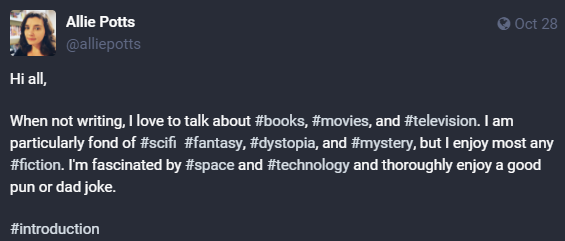
Screenshot of my initial introduction post which reads:

Hi all,

When not writing, I love to talk about #books, #movies, and #television. I am particularly fond of #scifi  #fantasy, #dystopia, and #mystery, but I enjoy most any #fiction. I'm fascinated by #space and #technology and thoroughly enjoy a good pun or dad joke.

#introduction

I will admit that joining yet another platform was not exactly high on my wish list, and I hate that I may have lost connection with some of my Twitter friends, but I’d like to think that our paths may yet cross again. In the meantime, I am enjoying the opportunity to make new connections, learn more tricks, and in some ways reinvent myself. If you happen to do the same, feel free to reach out and say hi. @alliepotts

A Collection of Micro Fiction Past

I often compare novel writing to running a marathon, and like running a marathon, you are more likely to survive the experience if you train. For me, pushing my creative muscles involved dabbling in the occasional flash fiction or taking part in a micro-fiction prompt. It occurred to me that recent changes to social networks, where many of these challenges take place, could soon result in the loss of many writers’ words unless we take steps to preserve them by republishing them elsewhere.

As a result, I thought it best to share some of my past entries through the years:

On Writing

Tap. I stare at the screen. Tap. The letter ceases to be. Tap. Pause. Tap. Nah, that’s not it either. Tap – the pulse of writer’s block.

My finger hovered over the publish button before dropping back to my side. No one will read this. Why bother? I shut the screen.

On Work

As she stared at the pile of bills, surpassed in size only by the pile of laundry, she moaned, “Why me?” The heavens answered – why not?

A figure—a gruesome visage—came stumbling into the room. Groans brought others. One reached for me. I handed over coffee. Our workday began.

Retirement is in my five-year plan, Joe told everyone each year. A decade later, he toiled still in the ground, while others rested.

On Life

I looked into a pane of glass. Windows of what if and could be reflected back at me. Behind me were a thousand might-have-beens. I stood in the center of the hall of mirrors, lost in the infinite possibility.

Hairs on the back of my neck tingled while thunder crashed all around, however, the time for fear was over, for I was the larger storm.

“A cup for every occasion! An occasion for every cup.” The merchant called. I walked on, preferring my poison straight from the bottle.

“Did you hear…?” Did you see…?” I listened closely. I was vain enough to think they were talking about me.

99% of patients experienced no side effects at all, the package read. Just my luck. I was finally a member of the 1%

The glow of the outlet store’s doors beckoned in the pre-dawn morning as deal hunters checked the ties of their laces. The race was on.

On Family

Her face, which caught my eye in passing, did not launch 1000 ships. She did better. She made our family whole.

Bits of colored paper, tangled string, and broken crayons. What others saw as junk, I saw as memorabilia of a childhood well spent.

She gave the children candy and took away their mother’s coffee. This Nana was not to be trifled with.

Some photos I take to record innocence of childhood. Others I take to help preserve innocence of a different sort for when my child tries dating.

I opened the door. My eyes widened at what I’d found. A pile of socks—lost from laundry days past—there once more. Magic must exist.

A peculiar odor tickled Nancy’s nose. Did Drew leave his socks out? She chased the scent. The hamster hadn’t gone to the farm after all.

Once there was a girl who laughed and loved. It was only when she ventured outside that she learned her life was considered a fairy tale.

Staring into the mirror, the girls chanted Bloody Mary. Laughing, they tumbled outside only to realize too late what had answered.

On Endings

$1,000,000 flashed on the screen. All I had to do was buzz in and claim it. A single word. A single answer. That was all I needed. BEEP!

A black screen reflected my image. I looked up from my depleted phone. I was the only one. My world was dark, though the sun shone.

Troubled thoughts swirled. Unanswered calls. Receipts for gifts unreceived. Her gut told her one thing, but her heart another.

A series of beeps, playing on repeat over radio waves. An upside-down flag. The zombies stumbled on, oblivious to it all.

The wave crested while we lay sleeping, its approach silent until far too late. I woke to the sea’s icy touch and then I knew no more.


If you enjoyed these short tales, I encourage you to check out more of my flash and micro-fiction. This can be found alongside of the work of a wonderful mix of other writers in The Shadows We Breathe, vol. 1 & 2, short fiction anthologies, edited by Sarah Brentyn.