
Mom sat on the couch across the room from me. A mug filled with coffee rested on the windowsill next to her as she regaled me with the latest news. Our most recent addition, a full-sized puppy—part Tasmanian devil, part wanna-be throw-blanket, had decided mom was no longer interesting. She’d taken herself and her chew toy elsewhere. But she’d be back. She’d always be back…
Watching for the inevitable return of the destruct-o-mutt out of the corner of my eye while mom talked has become a bit of a sport in and of itself over the last several months. Sure, the dog is a ball of cuteness, but if one didn’t pay attention to what was going on in the other room, if you were just a second too slow to adjust your position or to take action—well, you might just find yourself with a steaming puddle of coffee in your lap when she came back at full sprint.
Mom leaned forward. “So, I’ve been hearing a lot about AI… Should I be worried?”
There’s a story about Joe Kennedy, the father of the future president, and an encounter with a shoeshine boy. Supposedly, this happened back in 1929. I’m reminded of this story for no particular reason, but thought I’d share it anyway. Anyway, the story goes that almost 100 years ago, the stock market was going crazy. Joe had already been making money in the market for a while by then, but now so was everyone else. Everyone had opinions on potential trades and investments—many based only on secondhand information—including the lowly shoeshine kid.
One day, Joe goes to get his footwear cleaned up. While sitting on the bench, the boy offered up some stock tips.
It was likely just the kid’s way of making conversation in an attempt to earn an extra tip for his trouble. He probably thought nothing of it. However, Joe viewed the conversation differently. From his perspective, when kids who’d likely never seen the inside of a boardroom started to believe they knew enough about the markets to offer financial advice to random people they just met off the street, dumb, reckless decisions were bound to happen.
Joe took it as a sign. At a time when everyone else was betting on Wall Street’s continued boom, Joe took the opposite approach. He bet the other way. He took his money out. As a result, his money stayed safely in his pockets when the bubble finally burst. His family thrived through the Great Depression and is now in the various positions they serve today.
Interpret the Kennedy shoeshine story however you see fit, but back to mine…
“You want to know if I think AIs could kill us?”
She nodded. It’s worth noting that no one wanted my opinion about AIs and killer robots while Battlestar Galactica was on.
I’ll spare you the direct quotes, but the short answer is yes, I do believe these systems have the capability to inflict great harm. I believe this in the same way that I believe the destruct-o-mutt could break a mug and scald my lap with hot coffee. My dog loves to run. To jump. To be all up in your personal space. I recognize she has powerful jaws and an unstoppable wall of muscles that, once launched at you, just don’t quit. She’s a force to be reckoned with.
And yet…
It comes down to nature vs. nurture, opportunity vs. intent, program vs. programmer. My girl is the wussiest fur baby you’ve ever met. She’s afraid of fly swatters and things that go ‘pop!’ We’ve had to move her food dish around because the corner of the kitchen suddenly spooked her. She cowers in fear at the sound of these four letters: “B,” “A,” “T,” “H,” and high-tails it out of the room if she so much as gets a glance of the nail trimmers. The question, therefore, isn’t whether I believe she is capable of causing destruction—she is; it’s more like: do I believe causing full-scale destruction is the only option?
The answer to that second question is a resounding no. I can write this with great confidence. I love my dog. She’s a menace to society, sure, but she’s my menace. I recognize that she’s like Jessica Rabbit. She’s not intrinsically bad; she’s just drawn that way.
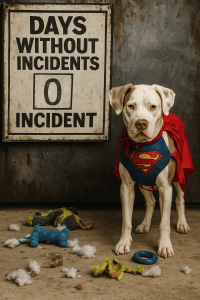
My goofy girl is intelligent and yet childlike in her innocence and eager to please. This combination has made her highly trainable (to an extent). It took her a few months, but she’s figured out the rules of our household and contributes in her own way. She understands a basic command (whether she listens to them every time is another story). She helps us stay healthier by keeping us active; she brings us joy and provides a needed snuggle or a bit of comical relief. She’s my office assistant and a sweet and loving companion. In short, she makes our lives easier or more difficult depending on the angle you look at it from, but always better by being a part of them.
A day without her knocking something over, slipping out of the gate, or ripping up one of her toys is never guaranteed, but I am not living in fear of what she might do. Why? Because I’ve made it a point to understand her. I’ve made it a point to anticipate how she’ll react, to establish boundaries and guardrails, and to do my best to limit her exposure to potentially dangerous environments. I check the gate latch. I put her on a leash on walks. I’ve listened to experts. I’ve been a responsible pet parent. I’ve been the adult in the room.
We need to listen to those raising the alarm. They know what these tools can do better than anyone. They saw it. They understand what’s going on behind the scenes. They trained these systems firsthand.
We’ve given these software systems access to our financial records and healthcare information. We’ve asked the tools to map out entire genetic sequences—they now have better access to the data about what makes us tick than we do. We’ve given autonomous software control of traffic lights and over our food storage. So the question isn’t: can AIs wreak irrevocable havoc on the human race? The question is: what can we do to mitigate this potential outcome? And that’s a decidedly more complicated answer.
I guess it just comes down to whether or not we are willing to be the adult in the room about it.


If we’re going to do something about it, we’d better get started soon.
LikeLiked by 1 person
Yesterday would have been a good day, but today works too.
LikeLiked by 1 person