Why Do We Walk on a Hot Summer Day

why do we walk on a hot summer day - www.alliepottswrites.comI went for a walk the other day.

It was hot, even by my southern standards. The mercury proclaimed the temperature to be somewhere in the mid-nineties. The density of sweat on the back of my neck suggested it was closer to triple digits (or thirty-seven for those who’ve long since abandoned the imperial system).

My children walked next to me until my youngest complained once too many that his feet were tired and was scooped up to be carried by his father. We still had at a mile or so to go.

Finally, we reached our destination. At least I thought it was our destination based on the number of people milling around. I honestly didn’t know.

I’d never gone on a walk like this before.

We lingered as more joined us in the square – bodies pressed together in the limited bits of shadow. Although there was insufficient protection from the morning sun, groups of people climbed up on planters, holding up cameras and snapping pictures of the view. More people arrived. Some shouted, some cheered, while others looked – much as I imagined we must have looked – confused and more than a little out of our depths.

My eldest son’s skin reddened as minutes ticked by. I handed him our single water bottle, encouraging him to drink. He looked up at me and asked for the tenth time that morning, “why are we doing this again?”

I glanced around, keenly aware that more than a few ears might hear what I had to say. “We’re here because this is one way to tell the people who make decisions that we think that certain things aren’t okay.”

“Oh,” he said. “Do you think they’ll listen?”

I looked at my son, who is now almost tall enough to meet my eye. I looked over his shoulder at the group of people holding up posters with witty, yet all too ignorable slogans. I listened to the shouts, some leaning more to the uncomfortable extreme. I looked into my son’s eyes once more. “No, sweetie,” I replied after some internal debate and a deep sigh. “I don’t.”

“Then why are we here?” he asked once more, taking another sip of water.

“Because I couldn’t stay away.”

I considered saying more, but then a siren sounded, a police car moved, and we were underway.

My son reached out and grabbed my hand as the crowd clumped and moved. “I don’t want to lose you,” he said.

I smiled, treasuring the moment in spite of the heat. “I don’t want to lose you either.”

We walked together that way – hand in hand – as a drum continued to play and pockets of individuals restarted their chanting refrains. My palms sweat, clutched so tightly by his, but he let go only to take another sip of water.

While we walked, he’d ask me questions, prompted in some part by the signs he read, which I did my best to answer as objectively as I could, considering the reason we’d left the comfort of our air-conditioned house that day. I wondered along the way if I was making any sense. I worried about how he’d taken my pessimism earlier.

A couple of days later the news showed a mother and daughter hugging each other. My son who’d been playing with his brother at the time looked up at me and smiled. “It worked, Mom. We did that.”

Technically, we hadn’t.

Aside from the fact that meeting of mother and daughter had been set up days to a week or so before, our particular contribution had barely registered as a blip on the news – overshadowed or outshone by bigger stories of the day. But as far as my son was concerned, that hug on the screen was his hug. He returned to his play, proud in the belief he’d made a difference in someone’s life that day.

Maybe he didn’t, but maybe he will.

Maybe someday he’ll go out there and truly make an impact, building on this experience, bolstered by the idea that we can make the world a little better even when it seems impossible. And all we have to do to get started is to simply leave our comfort zone once in a while, or get off the couch and try.

And that is why we walked on a hot summer day.

To my fellow Americans, I hope you all had a safe and happy Independence Day.

When Science Meets Magic – A Technology Round-up

science meets magic - a technology round-up -www.alliepottswrites.comIt has taken a bit to adjust to my new working schedule, especially as it pertains to writing for myself. When you find yourself researching and writing articles every day, it can be difficult to will yourself into remaining in your desk chair for an extra hour or two outside of regular business hours. If only the darn book would write itself, I’ve often complained. The story is there – swimming in my head. It’s just getting the words out on paper (or computer screen) that’s the problem.

Why don’t you try Dragon dictation? Some of my author friends have suggested. Once you get used to it, it is amazing how fast you can finish a draft.

Unfortunately, this would require I actually speak my story out loud. This means formulating the words to go along with the images floating around in my head, which is actually the hardest part of the process for me. Not only that, but I know from past personal experience, it isn’t a good idea for me to get into a habit of speaking as if no one can hear me. I tend to forget to turn it back off when I am around others.

Well, as luck might have it, I may just have a workaround soon. Back in April, researchers at MIT announced that they had created a wearable device that can ‘hear’ the voices words you say in your head, which is also known as subvocalization. The device itself looks like a cross between Google Glass and the headset used by a presentational speaker and picks up the electrical signals you generate when you think about words.

Speaking of Google Glass – Intel is coming up with smart glasses that actually look like regular glasses (source: The Verge).

But even then I am still a mom. Even if I am working in a cone of silence, there is still a good chance that either of my loving children will demand that I stop everything at once so that I might hear how they destroyed a creeper in Minecraft yet again. Did you know that in Minecraft’s creative mode, you can’t die? It’s true. And guess what, it’s still true five minutes later too!

If only I had an invisibility cloak. Oh, wait, that’s almost here too (source http://www.engadget.com).

Of course, then I also still have squeeze my writing in around weekly chores like folding the laundry. Thankfully my kids are now old enough to help out in this task, though they aren’t entirely reliable and often their little bundles have to be refolded before they can be put away. But maybe this won’t be a problem much longer either with the invention of a laundry folding machine Rosie from the Jetson’s might approve of.

Admittedly there isn’t much magic in this machine, but I want one all the same. As far as I am concerned, it creates time, which is a trick indeed.

Although, while I am on the topic of machines taking over time-consuming jobs, I was somewhat troubled to learn that scientists are continuing to hone in on what it is to be creative. In 2016, a computer ‘created’ a Beatles-esq song. Another computer, named “Shelley” has taken a crack at creative writing and is already working on its next anthology (source: livescience). And this was all before Google’s Duplex Assistant came on the scene and started tricking everyone into thinking a computer program was human.

What this means is the clock is ticking for me to finish my current works in progress before I have a whole new level of competition. Therefore it is best if I stop complaining about having no energy to write after work and get my rear back in the seat because science fiction is going to be science fact before you know it.

Project Gene Assist


Throwback Thursday – Be the change

Protest signI’ve had a lot on my mind this week. Too much actually. I find that the words are blocked and I’ve frankly run out of time. I am re-posting something I wrote back in 2014 which I feel is even more relevant today.
I was out-of-town for the last several days and was catching up on my reading when I came across a post written by one of my favorite bloggers. In her article she asked the question, do you ever involve yourself in a cause that doesn’t personally affect you?

Source: Be the change

That Vs Which: Self Editing Tip and Reason Number 501 Why it is taking so long to finish my next novel

I do not blog daily – my hat’s off to those that do – but that doesn’t mean I wasn’t happy enough to receive The Writer’s Daily Companion by Amy Peters as a gift several months ago. It’s like having my own daily prompt generator without the distraction that is the internet.

Somedays it’s a story prompt. Other days it is more of a workbook for improving your writing. For example, one of the Daily Companion’s lessons of the day was the difference between that and which.

It’s been a while since I published my first novel, An Uncertain Faith, and though I don’t obsess over the reviews nearly as much as I once did, I have never forgotten one review suggesting my writing could be removed if I didn’t use quite so many ‘thats.’

Imagine that.

To be clear, I was very appreciative of that particular feedback. Until I read that review, I had no idea that I said and wrote quite so many thats. Of course, now that it’s been pointed out to my attention I see that the reviewer might have a point. Then again, when you are writing books that are supposed to contain tens of thousands of words, it should be understood that a few words might just be repeated.

I also know my other half will forevermore lovingly point out future overuses of the word that – much to my dismay and embarrassment. (To be fair – I probably have it coming)

The tip is to remove the word that from a sentence. If it doesn’t make sense, the ‘that’ stays in. If it does – leave it out.

To be clear, I was very appreciative of particular feedback. This sentence doesn’t work. Therefore – hurray! I get to leave the ‘that’ in there.

Therefore, if I follow my own tip, I should edit my paragraph as follows:

To be clear, I was very appreciative of that particular feedback. Until I read that review, I had no idea I said and wrote quite so many thats. Of course, now it’s been pointed out to my attention I see the reviewer might have a point. Then again, when you are writing books that are supposed to contain tens of thousands of words, it should be understood a few words might just be repeated.

It’s better, but the next thing to obsess over is whether the word ‘which’ might be better.

That is a restrictive clause, while Which is an unrestrictive clause.

Clicks on the image will take you to an affiliate link

For non-English majors like myself, this means asking yourself if the sentence would still is accurate if you were to cut out any text following either qualifying word.

for example, if I cut out the “that are supposed to contain tens of thousands of words,” the last sentence of my paragraph would read like this:

Then again, when you are writing books, it should be understood a few words might just be repeated.

The statement is truthful and accurate. Therefore, my edited paragraph is:

To be clear, I was very appreciative of that particular feedback. Until I read that review, I had no idea I said and wrote quite so many thats. Of course, now it’s been pointed out to my attention I see the reviewer might have a point. Then again, when you are writing books, which are supposed to contain tens of thousands of words, it should be understood a few words might just be repeated.

The downside of this tip is I have to go through my work in progress with a fine-toothed comb, in order to tighten my writing before I send it off to the professional editor. This has been no quick and easy process. But I have to say the reviewer who first gave me the tip has a point (and thank you to all who have ever shared a review) and I look forward to being on the other side of edits soon.

And that’s all I am going to say about that.


How to quickly add some serious credibility to your business or your brand

How to quickly add some serious credibility to your business or your brand - www.alliepottwrites.comI love quotes. I love reading them. I love using them in my posts as a way to flavor my thoughts with another voice. The trouble is it sometimes takes me ages to find the perfect complement to whatever topic I happen to be writing on at the time.
Then there are the follow-up problems.

How to determine whether a quote is legitimate or not and who really said it? Take for instance the story about the valedictorian in Kentucky who attributed a quote in his commencement speech to one US president only to change its source moments later as a joke that wasn’t viewed as funny by some members of the crowd.

Stories like that prove that no matter how meaningful, empowering, or thought-provoking a quote’s message is, the quote’s mouthpiece also matters. So I try to be careful how I use them.

“With great power, comes great responsibility” – Spider-Man’s Uncle Ben (or was it?)

Up until now, my go-to source has been sites like www.brainyquotes.com and www.tinybuddha.com for when I am need of some additional zen. Both sites have nice keyword searching functions and I’ve created more than one post based entirely on a quote of the day, but there is no way of knowing for sure that the person cited is the first person (on record) to have ever said it. Hence the follow-up homework problem.

I have since found a new way to incorporate direct quotes straight from the source into the world of my other writing jobHARO. HARO stands for Help A Reporter Out (www.helpareporter.com) and it is a free tool for journalists (bloggers, podcasters, and authors too) that helps you find potential sources for upcoming articles.

The rules for journalists, bloggers, and podcasters are pretty stringent as they require your website or media outlet have an Alexa (yes, Amazon’s Alexa – because she’s EVERYWHERE) rating of 1 million or less. This score based on your site’s traffic. However, authors can use the tool to find sources for their books without a media outlet, but it can only be a request for less than 300 words and you must have an estimated publication date as well as a publisher (though I didn’t see anything that said it couldn’t be self) to be considered.

Sadly though, there is no “student” reporter program.

However, if you do meet their guidelines all you do is submit a query outlining your question, what you are looking for in a source, and when you need a response back. You need to be as specific as possible when describing your preferred expert to ensure you get the best sort of response for your platform or outlet. Once your query is approved by HARO, it is then sent out as part of several email blasts that go out throughout the day.

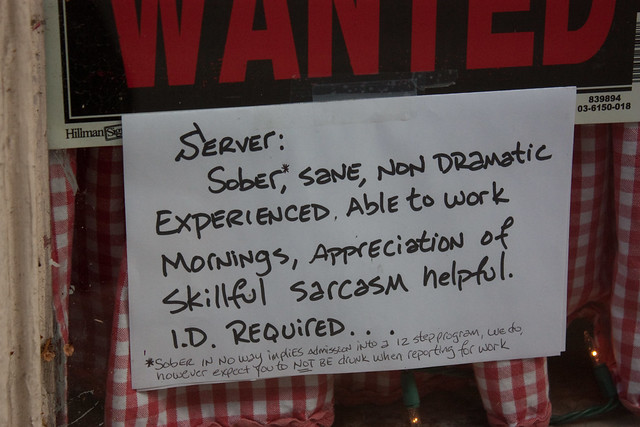
Help Wanted
image courtesy of http://www.flickr.com

But guess what, you don’t have to be a rockstar journalist or multimedia darling.  To use HARO to earn some extra cred for your book, business or brand, all you have to do is sign up as a source.

“And so it became that the quote lover became that which she loved: the quoted.” – so say I, from the book of me

The downside of signing up for the service as either a journalist or a source is the number of emails. There are so many emails. Three per day, and opting out is a frowned upon. But all those emails are filled with reporters just begging for potential interviewees, which are then broken out into various categories. HARO also offers paid plans to help filter by keyword if the emails start to get to you.

While you, as a source, can’t pitch your book, blog, or business outright, you can position yourself as an expert in your field based on how you answer the reporter’s questions. Then if your answer, or pitch, is accepted, you can get featured giving you access to a much larger media outlet, and access to your potential target audience without having to know a guy who knows a guy who knows a gal who used to babysit for the local section’s current editor.

Oh, and at a maximum of 300 words, it is a lot easier (and faster) to do than guest posting.

Though, seriously if you want to write a guest post sometime, that’s cool too.