What to do when the cloud is not your friend

Unfriendly Cloud

You take a road trip but aren’t asked to drive. You have nothing but time on your hands as you sit in the backseat for the twelve-hour drive. You are amazed to realize the car is actually quiet. You’d left the kids at home. There are no small people complaining about the need for snacks and a potty break every twenty feet. No arguments about someone’s elbow extending too far over the shared armrest or whose turn it is to pick the movie. You’d almost forgotten how travel, sans children, could be.

You think, I’d better take advantage of this rare opportunity to write. With that kind of uninterrupted time, you are bound to make some significant headway into your neglected manuscript.

You put in your ear buds and start typing. After a few false starts the words start flowing and they are beautiful. You know that deep down these are scenes that are going to somehow survive through editing relatively intact. Thousands and thousands of words later, you press the save button. A message box opens up. Upload pending.

Ah, that’s right. There is no WiFi in the car and you have your word processing program set up to sync automatically to the cloud, a precaution you took after you nearly lost a portion of your previous manuscript to your aging computer’s blue screen of death. You click a few more buttons and shut the computer down. The writer’s euphoria stays with you for the rest of the day. Man, that scene was awesome. You daydream about future glowing reviews. You start actually looking forward to editing if only to bring the rest of your draft up to the same high standard.

The next day you wake up refreshed having actually slept in your own bed once again. After the colossal effort from the previous day, you think today might let yourself off with a light writing day. Maybe catch up on a blog or two, or possibly write a piece of flash fiction for a contest, but first, you want to make sure you sync your previous day’s writing to the cloud.

You open your word processor. A message box opens. “Would you like to sync?”

Yes please, you think to yourself. A progress bar opens. As you watch the bar fill, your eyes happen to notice the side bar navigation. Funny, I am pretty sure there were more chapter headings there yesterday. You scroll down as the file completes its upload. No other chapter headings are shown. Odd. You start feeling bile build in your stomach as you jump to the last page in the file.

“I think I found stairs.”

It wasn’t the glorious last line you knew would keep your readers turning the page. No. They are the last words you wrote three days ago, the last words that were synced with the cloud before your road trip. You’d forgotten the function works in both directions. Fudge (except, like in the Christmas Story, you aren’t thinking fudge).

What to do now?

  1. Click on File>Recover Unsaved Version.
  2. Stare at the resulting message box declaring no unsaved versions while remaining in denial.
  3. Open up every single file folder remotely related to your document in search of anything at all with the word Backup in the name.
  4. Finding nothing, go online and search for any hacker tips out there that might allow you to somehow recover previous keystrokes.
  5. Whimper as you realize you are in over your head.
  6. While remaining in denial, notify your loved one of your tragedy on the off-chance they might be able to somehow wave a magic wand and bring your work back.
  7. Cry.
  8. Pour yourself another cup of coffee.
  9. Consider if it would be okay under the circumstances to spike said cup of coffee though it is before 9am.
  10. Consider throwing up.
  11. Return to the manuscript while giving yourself the whole, you wrote it once, you can write it again pep talk.
  12. Remind yourself that you are a terrible liar.
  13. Cry some more.
  14. Recognize that the diet is ruined and eat a cookie.
  15. Write something entirely different, maybe an attempt at a blog post so that others might share in your pain; someone, at least, ought to be laughing.
  16. Return to the scene of the crime (because that is what it is, cloud, that’s what it is!)
  17. Stare at your cursor.
  18. Sigh.
  19. Drain your cup of un-doctored coffee (pat yourself on the back for remaining strong).
  20. Start writing once more.


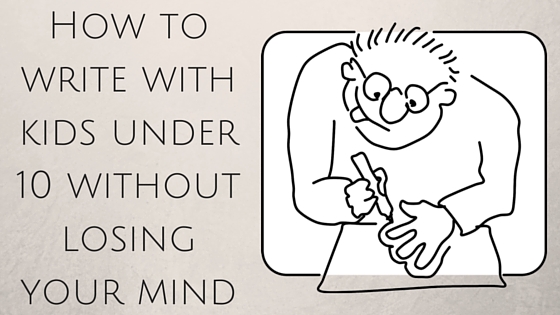
How to write with kids under 10 without losing your mind

How to write with kids under 10 without losing your mind
image courtesy of pixabay

Okay, so my headline is somewhat misleading. If you are attempting to write more than the occasional thank you note or note to the teacher about how very disappointed you were to learn of your normally charming daughter, Jenny’s decision to cut friend Mary’s hair in class, or why the teacher shouldn’t be alarmed when your son, Danny demands an extra seat at his desk for his imaginary friend, Mr. Hinklesworth, chances are your mind is already a little. . .well. . .off.

But according to my headline analyzer, “How to write with kids under 10 without losing more of your mind,” was considered too wordy.

1) Set boundaries

Set aside a little place in your world where you can go where you write uninterrupted. It is best if the only way to enter this place is by passing through a mystic portal accessed only by answering a series of three challenging questions administered by increasingly menacing figures, but I suppose any office, bedroom, or garden retreat or closet nook can do too. Just make sure that everyone knows that when mommy or daddy go to write they have effectively traveled to China (unless you already live in China in which case Kansas might do).

2) Actually enforce those boundaries 

Children can sense when adults want to do something that doesn’t involve them and it drives them mad. The little buggers will let loose a type of wall piercing shriek the likes of which the Department of Defense would pay billions to develop. Fight the urge to leave your writing sanctuary with every ounce of willpower you possess. You are supposed to be in China/Kansas, remember. Besides, it can’t be all that bad. As long as they are screaming, at least you know they are still breathing, right?

3) Schedule your writing in realistic chunks that fit your lifestyle

Yeah, who am I kidding in that last tip? No mind can withstand more than a minute or two of that sort of mental assault before caving. But once you leave your sanctuary, it unlikely your little hellions cherubs will allow you go back anytime soon, so you might as well plan accordingly. If you thrive on two to three hours sleep, writing in the early morning or late at night may work for you, but for those of us who require a few more REM cycles, it is easier to break up a day’s writing goal into a few fifteen to thirty minute sessions per day and can be an absolute sanity saver. Another blogger, Sacha Black, introduced me to this tip, referring to these micro sessions as writing sprints. She has written up a helpful piece to help you determine what size sprint is best for you.

4) Cut your cable

Better yet, turn the TV off altogether, but if you are like me and still occasionally need to veg out, do it smart. While the EU limits the length of commercial interruptions to no more than twelve minutes per hour of programming in the US, commercials can make up about 30% or more of air time. As much as it pained me at first, I’ve stopped watching live TV. Thanks to streaming without commercials, I can watch my favorite hour-long show in forty-five minutes. (It’s magic!) I now have an extra fifteen minutes to write if I so choose. Sure, it means putting up with some delayed gratification and extra heavy spoiler evasion, but we all must make sacrifices for our art.

5) Keep your deadlines long and your notes close

Even with the best of intentions, you aren’t going to be able to hit your goal every day, even with micro-sessions. You’ll have summer break or have to deal with yet another round of the bug that’s so fun to share that everyone in the family gets a turn. These things happen. The thing to keep in mind is unless you were offered a contract, the only one who cares about your deadline is you (yes, I know – I have a hard time accepting this too. I am all twitchy just to write it). Sure you might disappoint a few fans by failing to deliver as quickly as they would like (cough. . .cough. . . George R. R. Martin, I am looking at you), but they aren’t exactly lighting up your phone with offers to babysit (for free) so that you can write in peace, now are they?

6) Back-up everything!

Say you do all of the above. The children are blissfully asleep. Even better, they’d gone down with hardly a fight. Your partner is off taking a run (or doing whatever it is he or she does when you go all writerly on them). The house is wonderfully quiet as you revise the third draft of your latest novel. Only a few more chapters to go. You are in the zone. Suddenly the cursor on your screen moves and an ‘a’ you know you didn’t type appears on the page. Then another. And another. Suddenly there is a whole line of ‘aaaaaaaaaaaaaaaaaaaaaaaaaaaaaaaas’. Panicked, you bang on the ESC key. The cursor blinks at you as if it is not only aware of your fright, it is amused. Then the whole room is blanketed in a bright blue light coming from your screen.

You feel like Darth Vader just told you he was your father. NOOOOOOOOOOOOOOOOOOOOOOO!

Sounds horrible? Yes. It. Was. I was able to recover my file. That time. But thanks to the school system exposing the young to computer skills at a young age, I can no longer trust that my children won’t download a virus or click on a ransomware link. Heck, I can barely trust myself not to do that.

7) Remember why you started in the first place

Were you doing it for the money? The fame? The accolades? (If so, I’d love to see your marketing plan. Really – I would! Please contact me). Occasionally take a step back so that you can see how far you’ve already come. You can do this.

Onward and upward – fun with mind manipulation

Writing a novel is like running a marathon. You train and train, conditioning your body through smaller “fun” runs as you gradually build up some confidence and stamina. Then it is the day of the event, the thing you have been training toward for the last several weeks if not months. A crowd surrounds you. Their excitement is contagious. “See you on the other side!” and “Let’s do this!” You are anxious, but anything is possible. You take off.

Then, six miles later or so, you see that the course contains a hill (not to mention another ~twenty miles) and you start questioning why in the world you ever thought this was a novel idea (pun intended). You start contemplating veering off with the half marathoners, but that still means you have to somehow find it in you to run another ~seven miles. Ugh.

At this point, you realize you are thoroughly outta luck, so you might as well keep putting one foot in front of the other.

Image courtesy of Imgur

You adjust your pace and trick your mind into ignoring things like mile markers while instead focusing on smaller, more achievable goals. I just have to make it to that street sign or the next water station without walking. You look around and see spectator signs like “If this were easy, it would be called your mom,” or “remember you paid for this.” You’d laugh if it didn’t make you wheeze (or puke), but it is exactly the reminder you needed.

You may not get a spot on the podium, but you know that as long as you finish, even if you wind up crawling across the line, you are still getting a medal for your effort. It hurts to go forward, but you also know it just might kill you at this point to go back empty-handed.

I am at the base of that hill with my current work in process. Day job, illness, and life in general, knocked me off schedule. Even worse, as much as I want to push my characters forward, they seem equally determined to catch their breath. I am tempted to write in some zombies or talking animals from another dimension just to mix it up, except I’m pretty sure I would ultimately have to cut the scene out. I can feel my will to continue begin to be tested (oh, why didn’t I set out to write a short story, or at most, a novella?) But as starting another project (with zombies… no…, dragon zombies… from space!) or taking an indefinite hiatus (don’t even think it) are equally unacceptable options, I’ve come to the realization that it is time to start utilizing the tricks that kept me motivated two times before. It is time to pull out the signs.

In my case, that usually means mocking up a cover or two as I have an easier time visualizing my goal if I have an idea of what it might look like when I cross the finish line. Which brings me to cover design.

I am always on the lookout for ways to improve any aspect of my authorprenuerism and recently watched a special on the topic of something called the golden ratio, 1.618, or phi. Supposedly this near mystic ratio can be found among plants and shells almost as if the natural world was actually planned by mathematics. It is repeated in architecture such as the Parthenon and its proportions found in art like the Mona Lisa.

To create it, you draw a rectangle (one size is 1x, the other side is 0.618x). Then while keeping the rectangle’s proportions the same, rotate and resize the rectangle so that its longest side now fits within its shortest side (or… you can simply find a ready-made golden ratio template on the internet).

Golden Ratio
Golden Ratio (image courtesy of Wikimedia Commons)

Its use is also suggested to be a form of mind manipulation. There are those in the marketing world who believe that design based on this ratio is also more appealing to consumers that designs that do not. Intrigued, I decided to first test out how well my existing covers conformed to this ratio.

Golden-ratio-UFGolden-ratio-FFAccording to the theory, a consumer’s eyes are expected to naturally follow a line of curvature within the golden rectangle. The rectangles should then act as a guide for the placement of design elements.

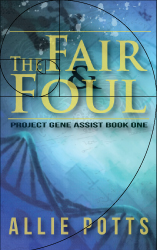
I was somewhat shocked but overall pleased to see that both of my covers roughly fit within the design rules I hadn’t previously known existed. For example, if the theory is true, a would-be reader’s eye is drawn to the chasm beneath the woman in An Uncertain Faith suggesting my main character’s trying situation while on The Fair & Foul, a reader’s eyes are drawn to my name which will help achieve brand recognition.

Of course there are others who believe that the golden ratio is purely a myth or that there are other more appealing rectangle sizes, but considering how important cover design can be to the success of a book, it is definitely something I will be keeping in mind moving forward.

And move forward I will.

I wanted to write, I really did…

I wanted to write. I really did!

But…

I needed to walk the dog. It was a glorious morning and the two of us could use some bonding.

Then the time slipped away and I still needed to work for my day job which meant traveling away from warm sunny temperatures. I wasn’t worried.

I should have time to write while I wait for my flight.

But…

The gate attendants kept making pesky announcements regarding weather delays, which had the worst way of breaking my concentration.

Dinosaur in Chicago airport
It was a really, really, really long layover

The incoming plane is delayed. The incoming plane has been sent back to its original gate. We found a new plane, but we’ll need a new crew. We need to file paperwork. We need to de-ice the plane. They need to clear the runway. We’ll be underway in just a moment…any moment…

That moment became hours as we waited on the runway. Use of electronics during this down time was strictly prohibited.

I still might be able to write while we fly.

But…

My seat mate was one of those people who don’t pick up on social cues. (I seriously need to meet with the various airlines about my “I’m feeling social / Do not disturb” patent pending travel bracelets).

Which actually was much more tolerable than the sound of the jet engine next to my ear, or the smell from the overworked restroom, but still less conducive to writing.

I can always write when I reach my hotel.

But…

After circled our destination five times, the pills I’d taken for the resulting massive headache hadn’t yet worked their magic. Looking at the blank screen was painful.

And I was hungry, tired, and grumpy to boot and knew I had to wake early for a morning appointment. I looked at the bed.

I wanted to curl up under the covers and sleep.

But…

My flight might have been cancelled were it not for the appearance of the new crew. They just happened to be on the flight as passengers but volunteered for an extra night’s work so that the rest of us sorry individuals huddled together might still reach our destination. Or we might not have gotten airborne had it not been for the ground crew working in freezing temperatures and horizontally blowing snow in order to grant us a clear path and ice-less wings. I may not have reached my hotel were it not for traffic control, squeezing us into an unplanned slot, or gotten to my hotel without my shuttle driver braving frozen roads. They did their jobs, because they had to, even though it wasn’t comfortable or convenient.

And I knew the following day would be just as hectic, just as I knew I didn’t start down this writing journey for lack of a hobby.

I ran out of excuses.

I needed to write.

So I did.

How not to gain a literary agent

How not to gain a literary agent
background image courtesy of Lissa R and Flickr

Ah, the quest for the elusive literary agent…

For my readers who are not writers, let me explain. You see a literary agent can seem much like a unicorn within the writing world. If you are fortunate enough to stumble upon one, the common belief is that they have the power to carry an inexperienced virgin writer to the doors of a major publishing house with a flick of their mane, and once there, they will have wishes like advances large enough to allow retirement from the day job bestowed upon them.

However, these magical creatures are elusive and prone to shy from abrupt noises or from anyone with less than the purest of hearts. And the quest itself isn’t without peril. Pretenders risk being torn to shreds by the unicorn’s horn and hooves, and that is assuming they find the real thing. There are plenty of other things out there that can destroy the would-be author’s dream, such as trolls hiding under coats of horsehide or fierce gatekeeper dragons.

The source of the unicorn myth likely stems from a misidentified oryx or ancient auroch, and a literary agent’s real powers are about as magical, but writers are dreamers. Over the last several months a few of my writer friends announced, with some trepidation, their intention to seek out potential agents. I understand their fear as I explored this option last year as well. Ultimately, I abandoned my search for reasons related to my goals for that specific project, but that didn’t prevent me from gaining some experience on the subject. So while I may not be in a position to advise on “how to” gain an agent, I thought I would, at least, share what I learned about “how not to.”

For those of you non-writer types reading this, the following tips can apply to job hunting as well. Just insert ‘resume’ for ‘manuscript’ and ‘potential employer’ for ‘agent’.

1. Send blanket queries to everyone in the phone book

Keep in mind that agents are salespeople and best salespeople are those who believe in a product they represent as much as they believe in making a dollar. Therefore, an agent who doesn’t enjoy gory horror isn’t going to appreciate your take on something like Saw. Save yourself some time, aggravation, and potential hope-crushing rejection by only querying those who are a) accepting unsolicited queries and b) into what you are into.

I had the most success looking for potential agents on Twitter. By reading their tweets, I was able to not only see what they were looking for but what kind of person they are as well. As a result, I was not only able to tailor my query letters to individual agents, but was able to rule out entire agencies where I didn’t see a good match.

In short, if you aren’t willing to take the time to get to know them, don’t expect them to take the time to get to know you. [update: If Twitter is not an option for you, alternatives like Mastodon, Discord, and Tumblr also have agents as active users]

2. Ignore the submission requirements

I haven’t stopped following agents on Twitter just because I didn’t sign with one. They have great tips and hint at what trends are selling (and where) which in turn helps me with my marketing. They also let me know about upcoming books to add to my to-be-read pile. However, just as often, they will bemoan about some would-be author who didn’t take the take to read their submission requirements.

Each agency’s requirements are different. Luckily figuring out what each agency needs to make a decision about your work is usually pretty simple. Go to their website and look for their rules. If a “Submission” link isn’t highly visible, it is a good indicator that they aren’t looking for new clients right now and you’d be better off searching elsewhere.

3. Submit an incomplete / unpolished manuscript

This one applies more to fiction than non-fiction.

You might be under the impression that you don’t need to polish your manuscript before submitting it to an interested agent because in addition to your big cash advance will come editorial services when they sell it to a publisher, so why spend the time/money now? This is a mistake. Apparently, no agent worth their commission has time to waste panning for gold with you. They are looking to sell ingots, not mud pies.

However, you can go ahead and start searching (better yet – networking) at any time. That contact you make a cocktail party, book fair, or conference might just remember you enough to spare your work a second glance when you finally are ready to get serious.

4. Protest their response

When my youngest starts to get tired, the rim of his eyes grow red and he tends to flop about on the floor, but the moment you try to pick him up to take him to his bedroom he will cry, kick, and scream about how not sleepy he is and every single time I will tell him that by acting the way he did, he just proved my point.

Agents aren’t going to be any more impressed with tantrums. If anything, you just firmed up their decision not to add you as a client.

5. Give Up

Of course, the best way to not sign with an agent is to simply give up. But Allie, aren’t you being a little hypocritical advising people not to give up when you admitted up top that you abandoned your own search last year?  No. To be clear, I’m not advising one way or another.

Signing with an agent is not for every person or every project. At the end of the day, every writer has to decide what works for them and the project. But regardless of the outcome, I believe querying is something that should be at least tried. Querying helps define your audience, refine pitch, and practice networking and if you are lucky, you may just find a unicorn. Happy hunting.