When Science Meets Magic – A Technology Round-up

science meets magic - a technology round-up -www.alliepottswrites.comIt has taken a bit to adjust to my new working schedule, especially as it pertains to writing for myself. When you find yourself researching and writing articles every day, it can be difficult to will yourself into remaining in your desk chair for an extra hour or two outside of regular business hours. If only the darn book would write itself, I’ve often complained. The story is there – swimming in my head. It’s just getting the words out on paper (or computer screen) that’s the problem.

Why don’t you try Dragon dictation? Some of my author friends have suggested. Once you get used to it, it is amazing how fast you can finish a draft.

Unfortunately, this would require I actually speak my story out loud. This means formulating the words to go along with the images floating around in my head, which is actually the hardest part of the process for me. Not only that, but I know from past personal experience, it isn’t a good idea for me to get into a habit of speaking as if no one can hear me. I tend to forget to turn it back off when I am around others.

Well, as luck might have it, I may just have a workaround soon. Back in April, researchers at MIT announced that they had created a wearable device that can ‘hear’ the voices words you say in your head, which is also known as subvocalization. The device itself looks like a cross between Google Glass and the headset used by a presentational speaker and picks up the electrical signals you generate when you think about words.

Speaking of Google Glass – Intel is coming up with smart glasses that actually look like regular glasses (source: The Verge).

But even then I am still a mom. Even if I am working in a cone of silence, there is still a good chance that either of my loving children will demand that I stop everything at once so that I might hear how they destroyed a creeper in Minecraft yet again. Did you know that in Minecraft’s creative mode, you can’t die? It’s true. And guess what, it’s still true five minutes later too!

If only I had an invisibility cloak. Oh, wait, that’s almost here too (source http://www.engadget.com).

Of course, then I also still have squeeze my writing in around weekly chores like folding the laundry. Thankfully my kids are now old enough to help out in this task, though they aren’t entirely reliable and often their little bundles have to be refolded before they can be put away. But maybe this won’t be a problem much longer either with the invention of a laundry folding machine Rosie from the Jetson’s might approve of.

http://www.youtube.com/watch?v=w8q85n7h8BE

Admittedly there isn’t much magic in this machine, but I want one all the same. As far as I am concerned, it creates time, which is a trick indeed.

Although, while I am on the topic of machines taking over time-consuming jobs, I was somewhat troubled to learn that scientists are continuing to hone in on what it is to be creative. In 2016, a computer ‘created’ a Beatles-esq song. Another computer, named “Shelley” has taken a crack at creative writing and is already working on its next anthology (source: livescience). And this was all before Google’s Duplex Assistant came on the scene and started tricking everyone into thinking a computer program was human.

What this means is the clock is ticking for me to finish my current works in progress before I have a whole new level of competition. Therefore it is best if I stop complaining about having no energy to write after work and get my rear back in the seat because science fiction is going to be science fact before you know it.

Project Gene Assist


That Vs Which: Self Editing Tip and Reason Number 501 Why it is taking so long to finish my next novel

I do not blog daily – my hat’s off to those that do – but that doesn’t mean I wasn’t happy enough to receive The Writer’s Daily Companion by Amy Peters as a gift several months ago. It’s like having my own daily prompt generator without the distraction that is the internet.

Somedays it’s a story prompt. Other days it is more of a workbook for improving your writing. For example, one of the Daily Companion’s lessons of the day was the difference between that and which.

It’s been a while since I published my first novel, An Uncertain Faith, and though I don’t obsess over the reviews nearly as much as I once did, I have never forgotten one review suggesting my writing could be removed if I didn’t use quite so many ‘thats.’

Imagine that.

To be clear, I was very appreciative of that particular feedback. Until I read that review, I had no idea that I said and wrote quite so many thats. Of course, now that it’s been pointed out to my attention I see that the reviewer might have a point. Then again, when you are writing books that are supposed to contain tens of thousands of words, it should be understood that a few words might just be repeated.

I also know my other half will forevermore lovingly point out future overuses of the word that – much to my dismay and embarrassment. (To be fair – I probably have it coming)

The tip is to remove the word that from a sentence. If it doesn’t make sense, the ‘that’ stays in. If it does – leave it out.

To be clear, I was very appreciative of particular feedback. This sentence doesn’t work. Therefore – hurray! I get to leave the ‘that’ in there.

Therefore, if I follow my own tip, I should edit my paragraph as follows:

To be clear, I was very appreciative of that particular feedback. Until I read that review, I had no idea I said and wrote quite so many thats. Of course, now it’s been pointed out to my attention I see the reviewer might have a point. Then again, when you are writing books that are supposed to contain tens of thousands of words, it should be understood a few words might just be repeated.

It’s better, but the next thing to obsess over is whether the word ‘which’ might be better.

That is a restrictive clause, while Which is an unrestrictive clause.

Clicks on the image will take you to an affiliate link

For non-English majors like myself, this means asking yourself if the sentence would still is accurate if you were to cut out any text following either qualifying word.

for example, if I cut out the “that are supposed to contain tens of thousands of words,” the last sentence of my paragraph would read like this:

Then again, when you are writing books, it should be understood a few words might just be repeated.

The statement is truthful and accurate. Therefore, my edited paragraph is:

To be clear, I was very appreciative of that particular feedback. Until I read that review, I had no idea I said and wrote quite so many thats. Of course, now it’s been pointed out to my attention I see the reviewer might have a point. Then again, when you are writing books, which are supposed to contain tens of thousands of words, it should be understood a few words might just be repeated.

The downside of this tip is I have to go through my work in progress with a fine-toothed comb, in order to tighten my writing before I send it off to the professional editor. This has been no quick and easy process. But I have to say the reviewer who first gave me the tip has a point (and thank you to all who have ever shared a review) and I look forward to being on the other side of edits soon.

And that’s all I am going to say about that.


How to quickly add some serious credibility to your business or your brand

How to quickly add some serious credibility to your business or your brand - www.alliepottwrites.comI love quotes. I love reading them. I love using them in my posts as a way to flavor my thoughts with another voice. The trouble is it sometimes takes me ages to find the perfect complement to whatever topic I happen to be writing on at the time.
Then there are the follow-up problems.

How to determine whether a quote is legitimate or not and who really said it? Take for instance the story about the valedictorian in Kentucky who attributed a quote in his commencement speech to one US president only to change its source moments later as a joke that wasn’t viewed as funny by some members of the crowd.

Stories like that prove that no matter how meaningful, empowering, or thought-provoking a quote’s message is, the quote’s mouthpiece also matters. So I try to be careful how I use them.

“With great power, comes great responsibility” – Spider-Man’s Uncle Ben (or was it?)

Up until now, my go-to source has been sites like www.brainyquotes.com and www.tinybuddha.com for when I am need of some additional zen. Both sites have nice keyword searching functions and I’ve created more than one post based entirely on a quote of the day, but there is no way of knowing for sure that the person cited is the first person (on record) to have ever said it. Hence the follow-up homework problem.

I have since found a new way to incorporate direct quotes straight from the source into the world of my other writing jobHARO. HARO stands for Help A Reporter Out (www.helpareporter.com) and it is a free tool for journalists (bloggers, podcasters, and authors too) that helps you find potential sources for upcoming articles.

The rules for journalists, bloggers, and podcasters are pretty stringent as they require your website or media outlet have an Alexa (yes, Amazon’s Alexa – because she’s EVERYWHERE) rating of 1 million or less. This score based on your site’s traffic. However, authors can use the tool to find sources for their books without a media outlet, but it can only be a request for less than 300 words and you must have an estimated publication date as well as a publisher (though I didn’t see anything that said it couldn’t be self) to be considered.

Sadly though, there is no “student” reporter program.

However, if you do meet their guidelines all you do is submit a query outlining your question, what you are looking for in a source, and when you need a response back. You need to be as specific as possible when describing your preferred expert to ensure you get the best sort of response for your platform or outlet. Once your query is approved by HARO, it is then sent out as part of several email blasts that go out throughout the day.

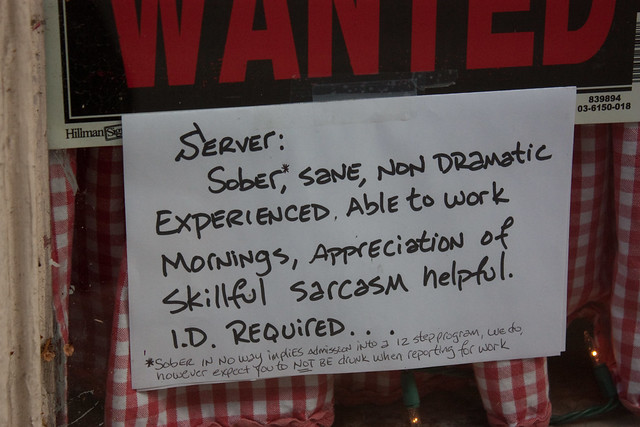
Help Wanted
image courtesy of http://www.flickr.com

But guess what, you don’t have to be a rockstar journalist or multimedia darling.  To use HARO to earn some extra cred for your book, business or brand, all you have to do is sign up as a source.

“And so it became that the quote lover became that which she loved: the quoted.” – so say I, from the book of me

The downside of signing up for the service as either a journalist or a source is the number of emails. There are so many emails. Three per day, and opting out is a frowned upon. But all those emails are filled with reporters just begging for potential interviewees, which are then broken out into various categories. HARO also offers paid plans to help filter by keyword if the emails start to get to you.

While you, as a source, can’t pitch your book, blog, or business outright, you can position yourself as an expert in your field based on how you answer the reporter’s questions. Then if your answer, or pitch, is accepted, you can get featured giving you access to a much larger media outlet, and access to your potential target audience without having to know a guy who knows a guy who knows a gal who used to babysit for the local section’s current editor.

Oh, and at a maximum of 300 words, it is a lot easier (and faster) to do than guest posting.

Though, seriously if you want to write a guest post sometime, that’s cool too.

5 Basic Things You Learn After Starting To Write Full-Time

5 Basic Things You Learn After Starting to Write Full-Time - www.alliepottswrites.comI haven’t been in my new position as a full-time writer long, but I am already learning a number of things about the process, especially as to how it pertains to online media – like how bad I am at it on this site (in terms of monetization, rapid audience building, or anything else you can think of when you try to come up with ways to actually making a living off writing outside of selling books, which is a whole story for another day), even when the writing itself was good.

For one, I don’t use nearly enough H2 tags in my blog posts, or headers for those not as versed in HTML lingo. Apparently, readers like to see big bold text so they know which words I spent hours upon hours tirelessly crafting are okay for their eyes to totally skip over.

That being said:

Be bold

Readers bypassing lengthy intros will jump directly to the text immediately under the header, so feel free to repeat yourself. Chances are they didn’t read it the first time you alluded to something in the opening.

Explain the benefit in clear and simple terms

You might think you are offering your readers a great value in sharing your story. After all, you are giving the very generous gift of your writing time when you probably should be spending that time on the last book in your science fiction trilogy or … I don’t know … relaxing (I hear that’s a good thing) and asking only that they give you minutes of their time or a comment or two in return. As a result, you might think the benefit to the reader is clear but is it? Is it really?

Don’t forget about SEO

Google and all its AI helpers scurrying about in the background like long, long web pages (as in hundreds if not thousands of words), filled with short, short paragraphs (5 lines and under will do) prominently featuring your primary keyword. They can be difficult to please like that. There are all sorts of other rules to follow for true SEO, but I’m still learning those.

End with a call to action …

Want to connect? Leave your contact information. Want them to sign up for your newsletter mailing list which had never been sold to third parties, and never will be, but also now is forcing you to create this whole privacy policy thingy in order to be GDPR compliant instead of writing a longer post? Tell them. People like instructions. Except for anarchists. But then again, you should never expect to please everyone.

Seriously – comment – sign up – or connect. I love to hear from you.

… but also leave them a reason to come back for more

Until next time.


How to remain focused on your goals when life is determined to get in your way

My eldest son became sick and not just with a little cold. No, he’d caught the flu. The same strain of flu that was being featured on every nightly newscast. Taking care of him, and monitoring his symptoms was an absolute must.

At the same time, the forecast called for snow. Again. It was in the 70s (22C) the week before, but I live in North Carolina. We can go through a whole year’s worth of seasons in a week. In fact, we add a few more to the list – there’s also pollen season and hurricane season too. (Yes, yes, Colorado – where you can have all four seasons in a single hour – I know we have nothing on you).

But normally it doesn’t snow more than once or twice a year South, which is exactly why my parents moved us here when I was a kid. As a result, most of the people who live around here don’t have a clue what to do when the white stuff starts falling other than to rush out and get milk and bread like it will become the new world currency.

I had just gotten my eldest dosed and settled under blankets when I received word that the school system would be releasing my other son three hours early. Snow hadn’t even started falling, but classes for the rest of the day were canceled.

I received another alert. Not only had the school closed early, the following morning’s opening would be delayed by three hours.

My eldest’s fever climbed to 102.6 (39.2C).

The family calendar showed my hubby would be going out of town the balance of the week.

And then beta feedback for my most recent WIP came back as a solid ‘meh,’ signifying major re-writes were required.

There were doctors appointments to make, prescriptions to fill, dinners to cook, and her royal highness to walk, not to mention the work which needed to be made up from missed school and the day job. While juggling all of this, I needed to re-write thousands of words per day if I had any hope of reaching my writing-related goals.

And yet, during my regular writing time, when most of the house is either quiet or asleep, I found myself staring at a black computer case. I didn’t even have the energy to lift the lid, let alone turn the machine on. I felt I’d broken something. My creative muscle simply refused to work.

Which brings me to the topic at hand – how to remain focused on your goals when life is determined to get in your way.

Give yourself permission to let something go

With the exception of the week between Christmas and New Year, I’ve been posting something on this site weekly for a few years. My posts, on average, are between 500 and 1200 words meaning I’ve published more than then three books attributed to my name on my Amazon author page. I take pride in my consistency. I view it as keeping my promise to you, but something had to give.

Recognize your priorities

As much as I love this blog – the outlet it provides and the community it builds, my number one goal isn’t to be best known as a blogger. Scaling back my efforts for a week, under the circumstances, was an easy choice to make (as was giving up on cleaning my house for a few days). In fact, I may adopt a practice suggested by Diana Wallace Peach over at Myths at the Mirror to take one week off a quarter as a way of refreshing the mind and spending time on the priorities that matter most to me.

Don’t confuse artificial targets with your real goals

What do you mean? Aren’t they the same thing? No. A goal is where you want your arrow to go. The target around the goal just helps you aim. Hitting the target alone isn’t enough. It’s the bullseye you want.

For example, my target was to release the sequel to An Uncertain Faith in May. That target, however, is really nothing more than a release schedule, a deadline to help keep me motivated day in and day out. My goal, on the other hand, is to write a book that lives up to, if not exceeds, the reader’s expectations. Quality, therefore, is my goal, and frankly, there is no way I can achieve that goal unless I am willing to shift my bow and aim at a target more reflective of my current environment.

Ignore the urge to splurge

Once you have agreed to let certain lesser priorities go and/or readjusted your timeline after a period of stress or frantic activity, you may find yourself with feeling like there is this hole you have to fill. I’ve been told others call this strange sensation, ‘having spare time.’ Unaccustomed to spare time you may be tempted to take on additional tasks or responsibilities which sound easy in theory but are not in line with either your priorities or your goals. Don’t.

Life will fill in that time for you just fine on its own. Trust me.

Accept that setbacks happen to everyone

Even to people who’d prefer to present themselves as having it all together.

I am disappointed to be sure, but I am not giving up, nor do I feel bad about giving myself a break. I will still have another book out this year. It may just be after the summer instead of in the weeks leading up to it. I am able to remain focused by keeping in mind a setback does not mean the end. I’m back in my chair, plotting forward once more. It’s all I can do.

Because most importantly, when life is determined to get in the way of your goals, the best thing you can do is:

Never stop trying