5 Reasons Your Book Takes Forever (and a Day) to Launch

I’ve said it before and I’ll say it again — writing the book is the easy part. For the past several weeks I have been practically chained to my desk getting Lies & Legacy ready for its big debut. Why does it take so long to publish a book after announcing the manuscript is done? I’m glad you asked.

If you are going to market via the traditional, or in some cases, the small press route, this is because the publishing house only wants to release a certain number of books at any given time so as not to compete against themselves. It’s an understandable concern, but frustrating from both the reader’s and the author’s perspective who are eager to get their hands on the book.

If you are publishing independently, it’s because of the following reasons:

1. Title Setup Forms

To independently sell a book, in a bookshop or online, it needs to first be setup in a retailer’s database. This means there are forms. So many forms. You have to register your book’s ISBN, which is an identification number used in the US and other markets by booksellers to ensure that books with the same title or author name don’t get mixed up on orders.

Then there are retail setup forms that need to be to filled out. If you are feeling masochistic ambitious, you can set up your book on each of the retail platforms individually. WideWizard is a browser extension that can help speed up this process. However, a distributor like Draft2Digital (affiliate link) will do this for you (but some take a portion of your sales, so there’s that).

2. Author Proofs

If you’re only interested in publishing an ebook, you can skip this step. However, if you are like me and want an actual physical book to gaze at lovingly, place on display like a trophy for all the world to see, or simply read, there’s the proof stage.
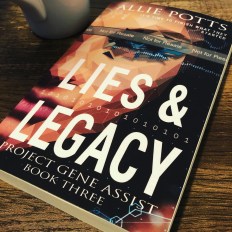
Technically, you can approve a book on Amazon or IngramSpark without ever actually laying your hands on a physical page, but I don’t particularly recommend it. I’ve learned the hard way that gremlins delight in sneaking in last-minute typos — the type you can’t catch in electronic format, no matter how many times you run your manuscript through editing software.

Unfortunately, this means you have to wait for your book to be printed, bound, packaged, and shipped to your door before you can move on to the next step. That said, there is something magical about receiving that first proof copy — even if it is has a big banner on the cover making it clear the book is ‘not for resale’ or if it does contain more than a few errors.

3. Revisions

As I mentioned, there are gremlins in publishing. I’ve received proofs with my name cut off on the spine, page numbers missing, length too tall, and random blank pages inserted in the middle seemingly with no sense of rhyme or reason. Seriously, NEVER publish a book without requesting a physical proof.

This means your files will require a round of revision. You’ll have to update your files and make sure that this time you REALLY take the time to visually inspect each and every single page (all 300+ of them, in my case). I don’t care how sick you are of reading your own story. DO IT.

4. Buzz Building

Superfans are awesome. Superfans count down the minute to your launch. They add your launch date to their calendars in permanent ink and put in a request to take the day after your launch off of work if only so they can stay up all night reading. Unfortunately, most people aren’t superfans — no matter how much they say they love your work.
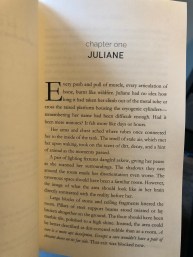
excerpt of Lies and LegacyYou have to build excitement while reminding people you have a book coming out. There are a number of ways to do this: post repeatedly on Facebook (but not too much or you can get yourself reported as spam. You can hop around other people’s blogs or post sneak previews on your own. (Psst – You can see an excerpt of Lies & Legacy on mine).

You can pay to get featured in a newsletter or negotiate a swap. You can also signup with a service like BookSweeps.com to be a part of a giveaway. Just note, you often have to schedule these at least six weeks in advance.

5. Reviews

While there’s no one way to launch a book, you’ll have the most success if you have reviews to go with it, as apparently few people (outside of the superfans) enjoy being the first to give your book a try. But it’s getting harder and harder every day to ensure your book has reviews when it is time to go live.

Amazon will flag reviews it deems as coming from a potentially biased connection. Sure, occasionally a real-life friend or acquaintance’s review will still get past Amazon’s quality checks, but I know of reviews being reduced to digital ether simply because the review came from an author’s Facebook page follower.

I’ve reached out to known book bloggers in the past, and will continue to do so in the future, offering an advance copy in the hopes they might provide an honest review. However, they are under no obligation to do so and there is always the risk Amazon won’t accept the review, which is why they also are free to post it when and wherever they want. It’s totally up to them.

This is why I have also started using BookSprout.co to handle my advance review requests. It takes me out of the equation. (It also has a sales report and keyword research tool if you are interested).

All I had to do was give them my ebook files and links where I’d like to see reviews posted. They take care of all the rest.

I worried about pirates the first time I used them, but the site seems to police itself. I also worried about the quality of the reviews, but all I’ve thus far received have been thoughtful and well-written. Unfortunately, they no longer offer a free plan for their services, but its entry-level paid plan is more affordable than what other review services charge.

I just wish they offered the option to purchase one-time review campaigns rather than a monthly subscription as months (or years) can go by between my publications. Even so, I’ve found it to be a worthwhile service overall for people who are trying to get reviews on other distributor sites (not just Amazon) or gain followers on Bookbub.

Speaking of which, you can click on the button below to follow me on Bookbub to see what I’ve been reading in between writing.

follow-me-on-bookbub-1

Lies & Legacy: Project Gene Assist Book 3 launched March 26, 2020

Editing Tools For Writers

Writers, whether they pursue traditional publication under the writer-agent model, publish under their own name, or sign with a smaller imprint, need to edit their work prior to submission. However, while some authors believe their background makes them a grammatical expert, the truth is no one should rely on a single set of eyes.

Unfortunately, professional editing services cost money, and as most reputable editors charge by the word, the cost to help you polish a full-fledged novel quickly adds up. I understand the temptation to do without. That said, I’ve also spent more than I would like to admit on editing services for words that, upon hindsight, never stood a chance of making it to the final proof copy.

Thankfully, while no online editing tool or plug-in is good enough to replace a set of human eyes—for now, there are several programs on the market today that can help you identify more than the occasional typo. Many can now check for tone, misused words, readability, and even provide recommendations to help your pacing. Even better, many of them are offered for free or at a price point that is low enough to pay for itself in short order.

As a result, editing software programs are critical applications for every aspiring author’s toolbox and can help you bridge the gap between rough draft and editor ready. I’ve used dozens over the years, some with more success than others. To save you from making many of the mistakes I have, I’ve compiled this list of those I’ve found to be the best for fiction and non-fiction writing.

editing tools for writers

Grammarly

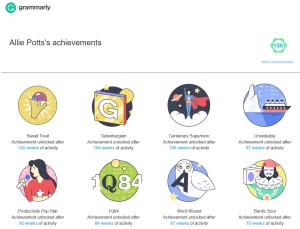
According to my Grammarly dashboard, the program has been correcting my text since 2015, so it’s a tool that has definitely impacted my writing. In fact, it has caught at least three errors in this paragraph since I started typing. That said, I’ve found the program misses errors occasionally when I’ve used it with Google Docs and I’ve had to disable it altogether on certain websites, like VistaPrint, as it doesn’t play nice with their text box editor.

Occasional bug aside, Grammarly has a free plan that works well as a spellchecker online via its browser extensions or as a Word plugin. However, there is also a premium version of the service, which can help you check tone, sentence variability, and make sure you aren’t inadvertently plagiarising online content.

Grammarly Achievements

  • Pros – It’s hard to beat free and is great for catching things like passive voice, incorrect punctuation, or misused homonyms in your daily writing. Plus, Grammarly sends out weekly progress reports telling you fun things like how unique your vocabulary is or how long you’ve kept your writing streak going which is great for staying motivated.
  • Cons – It’s much better suited for shorter business or online writing than creative long-form writing as it requires you to disable features like track changes in Word to operate.

ProWritingAid

ProWritingAid is another editing tool you can download and run as a plug-in with Word or Scrivener to check your writing or to check your writing online using its browser extension. Like Grammarly, its Chrome extension is free, however, in my opinion, its paid features, like its overused, cliche, echo, and consistency reports are well worth signing up for the premium version if you are a novelist.

prowritingaid reports

  • Pros – I can’t even begin to describe how much time this tool has helped me save looking for things like a missing quotation mark at the end of dialogue and identifying my clutch words and phrases. It is also more stable than Grammarly in certain web forms.
  • Cons – The plug-in for Word doesn’t always load correctly the first time, which has caused me to shut down Word and re-open my file on a semi-regular basis. In addition, the reports it runs can be somewhat overwhelming and do take a while to complete a check for a full manuscript.

Fictionary

Full disclosure, I am somewhat biased as I was invited to help test an early version of Fictionary, but I absolutely love what this program has to offer (they’ve also added a ton of extra features since then). Unlike all the other tools in this list, which I consider more copy-editing software, Fictionary is designed to help you automate a development edit.

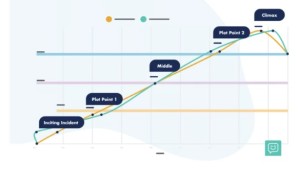
To use it, all you have to do is upload your manuscript and tag where your plot points are located. Fictionary will then tell you if your pacing is too fast or too slow with a graphical representation of the story arc. It can also help point out things that can help strengthen your story like are the five senses represented in each scene of your writing, has a character gone missing from the story, or are you varying your openings and closings enough to keep your reader interested.

Fictionary Story Arc
graphical representation of the story arc from Fictionary.com
  • Pros – While I still put more stock in beta reader feedback than I do a computer program, allowed me to perform a proactive developmental edit before I risked my reputation or burdened advance readers with a two-dimensional story.
  • Cons – Fictionary advertises that it can help you evaluate and revise your manuscript against 38 story elements. This sounds like a pro, until you are actually ready to make all those edits. If you are a pantser rather than plotter, you may not have had a goal for each scene in mind related to the overall plot or may have included scenes you loved to write, but don’t serve any purpose. Tagging all these elements in the software can be overwhelming as well as time-consuming. It’s also not free, which is understandable given its value but does offer a free trial.

Hemingway App

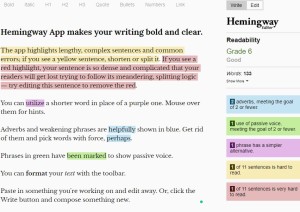
The Hemingway App, also known as the Hemingway Editor is offered as either a online editing tool or as a desktop app designed around making your prose more like Ernest Hemingway’s. That is to say, it will help your writing get right to the point, which is clearly something I need more help with. The tool highlights sentences that it deems too long, identifies adverbs that are keeping you from showing rather than telling, and warns you about passive voice, and gives you a readability score which can help you better connect with your target audience.

HemingwayApp

  • Pros – The free online tool loads quickly and features easy to interpret color codes which change in real-time as you edit your copy. The paid desktop version also lets you publish directly to WordPress and Medium, making it a great editing option for serialized stories.
  • Cons – Not everyone is a fan of Ernest Hemingway’s style of writing. Was I forced to read 127 pages about an old man trying to reel in a marlin? Yes, I was. Did I enjoy it? No, I did not. Also, it does not integrate directly into other word processing programs, meaning you can use it to tweak your copy, but then will need to export it to Word, text, or PDF before you can do anything with it.

EditMinion

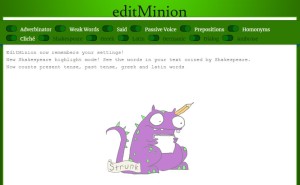
Before I bit the bullet and purchased the premium version of ProWritingAid, I used EditMinion to help polish up my work before sending it out for a professional edit. EditMinion is a completely free online editing program, that helps identify cliche phrases, passive voice, adverbs, and missing dialogue tags. However, it relies on copy and paste, and can only check a chapter of your text at a time.

EditMinion

  • Pros – It’s simple and you can’t beat the price point. Also, because there is absolutely nothing to download, you don’t risk corrupting your files or crashing other applications.
  • Cons – Copying and pasting each chapter one by one into the program can feel agonizingly slow, especially when you feel like you are so close to the literary finish line you can practically taste it. The tool also does not help your writing outside of the app or let you know if you have accidentally misspelled a character name. As a result, I use it when I need a second opinion but rely on the other products for heavier edits.

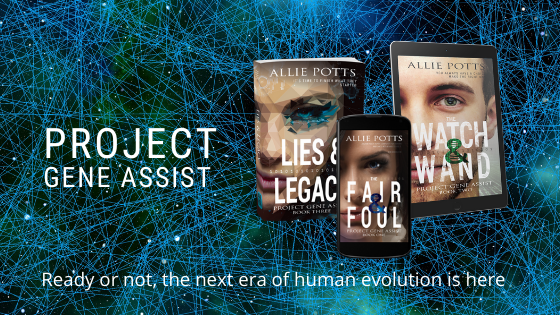
I am delighted to report I have reached the end of an editing project yet again and will be releasing my fifth full-length novel, Lies and Legacy: Project Gene Assist Book 3 to the general public in March 2020. You can read more about this series by visiting my Project Gene Assist book page, or by visiting your favorite online retailer to pre-order a copy.

Project Gene Assist Series Banner

Getting Started: Writer Problems Edition

Why do so many people who talk about one day writing a book fail?

Because finding those first words to mark on an otherwise empty page is a thousand times tougher to do when you decide this time you are going to start getting serious. Instead of writing anything, you simply sit there, staring at a white screen or a blank sheet of paper until you either get too frustrated, bored or otherwise called away by the real world. It can be brutal.

It’s not quite as hard as it is to stick with a novel weeks and weeks later when you’ve reached that saggy center typically devoted to world building, supporting character development or introducing the occasional red herrings, and all you want to do is move on to the next big idea, but pretty darn close.

But back to the empty page.

One of the reasons it is so difficult to get started is that many writers, myself included, feel pressure to shine with the very first line. There are a hundred, gazillion articles and pieces of advice out there (that’s likely an underestimate) on what you should do or not do when opening your story.

Don’t start with your character waking from a dream.

Do start with a flashy first hook of a line that will make the reader want to continue.

Failure to follow these rules, or open your story right will cost you, readers. credibility, sales. The love and respect of your family (who you suspect secretly wish you’d abandon this whole writing for a living dream and focus your effort on something more realistic – like getting the kids to school on time or paying bills). So, there’s no pressure to get it right or anything.

It took me a couple of tries, but eventually, I figured out a trick for getting over this fear –

Write the ABCs. Write your grocery list. Write absolute garbage. Just write something. I’ve found that words are like guests at a party. No one wants to be the first on a dance floor, but once one or two are out there and appear not to have a care in the world, the rest will follow.

That being said, I am now faced with an entirely new and unexpected writer problem.

You see, one of the benefits of my nice shiny new home is the fact I now have my own dedicated office where I can do all sorts of writerly things rather than force-fitting a forty to sixty-hour working week into a two-foot by two-foot square, partitioned from a larger room. The drawback is I haven’t had a clue what to do with all this extra space. It’s like the blank page staring at me, and I’m having a difficult time knowing where to get started.

The desk my other half so painstakingly made for me was built into the walls of our last place. Meaning, I am working with a relatively blank slate at the moment as far as furnishing goes. More specifically, I’m working off a card table.

Oh, and the zero key is still missing. Yes, its nothing but the best for me.

Logically, I know I solving at least one of those problems should be easy. I just have to find a desk I like and hope that the rest of the room’s design will soon follow. However, this is proving to be no simple task. It needs to be wide, but not too wide, as I want to be able to walk around it. With storage for my style guide and other tools, and I want it to be made of wood, but not the manufactured wood that falls apart the second you try to move it.

In short, I want it to be perfect. Hence, here I am, weeks later, paralyzed by indecision, still writing out the word zero and trying not to jostle the surface too much so as not to knock my coffee over. Even so, I’ve somehow managed to write close to 70K words on my latest work in progress (the third and final book of my Project Gene Assist series).

Part of me now worries changing my setup now will upset the creative muse (she is a fickle thing indeed), while another part is pretty sure I would be further along if I’d made a decision sooner. In either case, while I still have a long way left to go before I can say I am finished with this one, it’s, at least, a start. And the start is the hardest part indeed.

Happy Anniversary and the Difference a Year or Five Makes

“There are two great days in a person’s life – the day we are born and the day we discover why.” – William Barclay

Sadly neither of those days is today. However, I did receive a message informing me that yet another year has come and gone since I started down this whole blogging thing. I decided to celebrate by reflecting on my original goals and how life (and what I post about) has changed since then.

Happy Anniversary - what a difference a year or five makes - www.alliepottswrites.com

quotes provided by http://www.brainyquote.com

When I originally started out, my intent was to establish a platform in support of my novel, An Uncertain Faith, which is a women’s fiction / cozy mystery mashup (and its sequel is now officially out as well). As it was my first attempt at publishing a book, I knew I was in no position to proclaim myself an expert on either the writing or publishing process, but at the same time, I didn’t want to come across as someone who was simply winging it without a plan by sharing ALL the things I didn’t know.

“It is better to keep your mouth closed and let people think you are a fool than to open it and remove all doubt” – various sources, but often attributed to Mark Twain

In the end, I thought the better strategy was to rule out writing as a focus as many other authors tend to do. However, I still liked the idea of sharing tips or tricks, or weekly takeaways I’d picked up along the way, which, over time, proved to mostly center on the lessons I was learning from my kids. Some were sweet lessons, while others were more akin to the following:

“Never have more children than you have car windows.” – Erma Bombeck

This strategy worked for me, though family anecdotes rarely go viral, and when they do, it is usually for the worst sort of things. Nonetheless, the content itself was easy enough to generate. All I had to do was look out my window or down the hall. My weekly posts became a sort of happiness journal – a reminder of all the things I was grateful for, and all the reasons I had to celebrate.

At some point, without intending it, this blog had stopped being a way to promote my books and my writing to a general audience but instead evolved into a way to promote myself to the internal me. I guess that is the magic of writing. You never really know what the end result will be until you first start trying.

“Writing is like driving at night in the fog. You can only see as far as your headlights, but you can make the whole trip that way.” – E.L. Doctorow

However, my kids started to grow up. They started to read. Even worse, they started having lives and personalities of their own. Unfortunately, a nagging thought began to take hold in the back of my brain: I’m their mom, and they’re still my kids, but was that really enough to give me the right to share their stories (beyond the basic funny thing they’ve said) with the general public, even if I am doing my best to protect things like their faces or their names?

For a time, I thought so, but now I’m not quite so sure.

“Always be nice to those younger than you, because they are the ones who will be writing about you.” – Cyril Connolly

And so, I’ve found myself scaling their stories back, though they remain ever at the forefront of my mind. At the same time, I’ve grown older evolved too. I’ve moved on from that earlier version of me, the one who didn’t know how much she needed the weekly written reminders of the small joys as much, if not more than, public acknowledgment of the major accomplishments.

I say this because I was able to keep a promise to myself. I took a risk and made a change. I’m now working full-time in the world of online publishing, which in some ways is completely new for me, but in other ways strangely reminiscent of the world of consumer tech, sales, and project management I left behind. Overall, it has been a positive experience, but if I thought I didn’t know a lot about publishing back then… well let’s just say:

“I have not failed. I’ve just found 10,000 ways that won’t work.” – Thomas Edison

As a result, I’m continuing to give myself permission to mix things up from the way I’ve done them before. Therefore, while this post may have been prompted by a celebration of my blogging longevity, I’ve decided to relax my self-imposed rules for the balance of the year if not a few weeks longer. It’s not a hiatus per se, as I’m going to still try to post as I am inspired, but if life takes precedence over the written word some weeks, so be it.

However, I am also considering posting on a different day or at a different hour, testing, and refining until I find the combination that works within my new normal. (I may also ask my boys to sign a waiver allowing their mother to post with their permission). Who knows what changes life may bring in the coming year? I sure don’t, and that’s okay. Thus far, not having all the answers has worked out for me far better than I could have ever imagined.

“Sometimes it’s the smallest decisions that can change your life forever.” – Keri Russell

I know this small decision might cause additional ripples of change in my future, however, I’m not worried. Because, while I might love consistency and know too well the benefits of having a set schedule can bring, of all the things I’ve learned over the years, appreciating the value of the small things (both the good and the bad) as much as the big things, is the one lesson this blog has taught me how to do best.

How Not to Launch a Book in Ten Easy Steps

This time next week, I’ll officially have four novels with my name on them. Four. I can hardly believe it, but it’s true. You would think that this would mean that I’m quite the expert on launching a book, but sadly this is another example of something I’m far more qualified on the topic of what not to do.

1. If it is your first project, don’t wait to start building up a presence on social media, blogs, or working on growing your mailing list until after the book is for sale. For some strange reasons telling people about your book after it is officially on sale doesn’t exactly make for the best opening weekend.
2. If it is a sequel to that first project, consider launching it within a year of the first in the series, if not sooner. You might have been obsessed with your characters and the world over that time, but apparently, readers move on during that time. Readers can be fickle like that.

3. If you do mistakenly wait for more than a year (or five), consider re-reading your original time or two before attempting to write the sequel. You might think the fact that you read and re-read your original novel twenty-gajillion times during the editing process would mean you have your character’s mannerisms and tone etched into your bone. You’d be wrong.

4. If you go ahead and write the novel without revisiting your original story and send out a half-baked manuscript to early readers, don’t be surprised when they tell you your story is flat (but in the nicest, most constructive, supportive way).

5. If you did send out a half-baked story, don’t spend more than a week questioning all your life choices leading up to this moment of misery while pondering if it might be better to change your name and start again in Idaho (which I hear is lovely), or similar place.

6. If you do decide to give yourself a break by pushing out your self-imposed publishing calendar from the Spring to the Fall, don’t think all that extra time means you can’t still be working on it.

7. If the stress of working on a seemingly never-ending project did get to you and you found yourself going on a vacation, savor that time with your family or friends, but know you will have to kick the work into overdrive the minute you get back.

8. If you did allow bad habits to creep back into your process while you indulged in a few weeks of rest and relaxation, write out a marketing and production plan the day you return so you can start planning out your tasks and get your head back into the game as quickly as possible if only to make up for lost time.

9. If the words “marketing” or “production” plan put you on edge, know you are in good company. However, know that you still have to do these things even if you’d rather put your fingers in your ear and sing lalalalalalala. Therefore, you might as well get over yourself and find a way to write that stuff down, but more importantly, follow-through. You’ll save yourself a ton of heartache later.

10. If your eyes completed glossed over #9 as some sort of mental denial, or you are already coming up with a dozen or more reasons why there was always something else more pressing to do, well then you too might just find yourself a week from launch day in a state of mild panic realizing that while you do have a completely re-written book itching to go on sale, you only a handful of advanced reviews scheduled, and absolutely no blog tour stops or social media events planned on your calendar.

It’s not an insurmountable situation, but the alternative is much to be preferred.

And that, my friends, is how not to launch a book.


Living happily ever after is a full-time job.

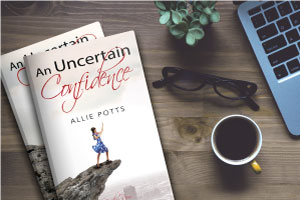
Uncertain-Confidence-www.alliepottswrites.comCharlotte’s life is on an upward swing. She’s in business with her best friend and her art is finally getting noticed.

Nothing could possibly go wrong … until everything does.

One disastrous night out ends with the sudden collapse of her best friend’s husband, putting him in the hospital and leaving Charlotte to manage things alone.

Uncertain about her ability to keep her business and her aspirations for artistic stardom afloat, Charlotte enlists the help of a stranger who promises to make her dreams come true. But in doing so, Charlotte may learn just how dangerous trusting the wrong person with your dreams can be.

Will Charlotte’s confidence prove to be her greatest strength or will it be her greatest mistake yet?

An Uncertain Confidence is a sweet contemporary story and fast read about friendship, trust, and the lengths we often go to protect those we love.

On Sale Oct 24th

Read an excerpt